
Adverb Examples – With Sentences and Types
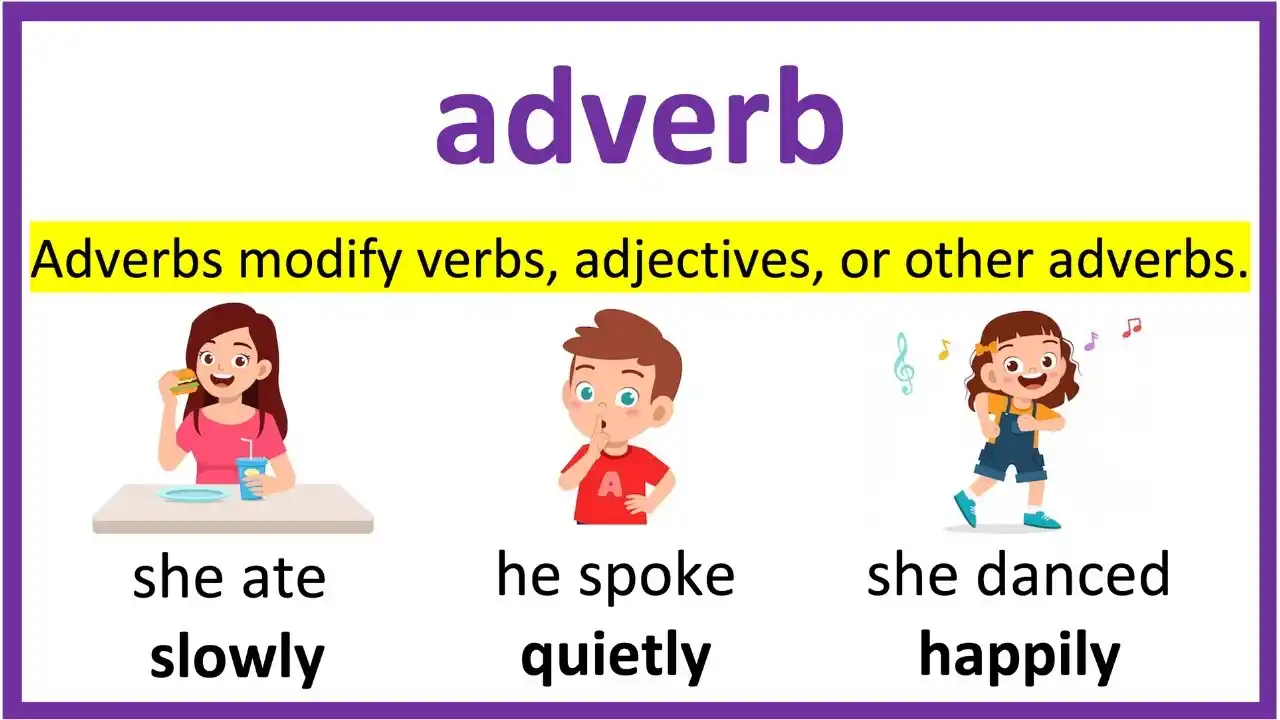
Adverbs are an essential part of English grammar. They give us more details about how, when, where, why, and to what extent an action takes place. In other words, they modify verbs, adjectives, or even other adverbs to make communication clearer and more expressive.
This guide will help you understand adverbs better with definitions, examples in sentences, and FAQs.
Table of Contents
- Adverb Examples
- Adverbs of Time – When an Action Happens
- Adverbs of Manner—How an Action Happens
- Adverbs of Place – Where an Action Happens
- Adverbs of Degree – Extent of an Action
- Adverbs of Frequency—How Often an Action Happens
- FAQs on Adverbs
Adverb Examples
Adverbs make sentences richer and more descriptive. Instead of saying “She sang,” we could say “She sang beautifully”—and that one word changes the impact completely.
Here are examples, divided into categories for better understanding.
Time – When an Action Happens
- I go to school every day.
- I came home yesterday.
- We went to the clinic last week.
- Sandra will go to London next month.
- My cousins are going to see a movie tomorrow.
- The food we ordered will be here soon.
- Will you come with me to the store the day after tomorrow?
- She came home late.
- Come and have breakfast now.
Manner – How an Action Happens
- She was walking slowly.
- My friend and I ran quickly to catch the bus.
- He stopped the car abruptly.
- My grandfather smiled cheerfully.
- Dina spoke boldly in front of the crowd.
- Sarah drove cautiously as the road was steep.
- They got here easily.
- Little Diana had dressed elegantly for her birthday.
- Blake waited eagerly for his surprise gift.
Place – Where an Action Happens
- I would like to go somewhere to relax.
- Serena had to go downstairs to collect the mail.
- I carried my umbrella with me when I went outside.
- Tom searched everywhere for the missing key.
- They opened a shop nearby.
- She took her brother inside when it started raining.
- The baby crawled towards her mother.
- What are you doing here?
Degree – Extent of an Action
- I was completely satisfied with the result.
- The doctor was not fully aware of the patient’s history.
- Mom was extremely tired after work.
- Amy regretted her mistake deeply.
- The boy was least bothered about the mess.
- Raina barely knew her neighbor.
- The teacher was highly appreciated for her efforts.
- The dress fit her perfectly.
Frequency – How Often an Action Happens
- I take the metro daily.
- She seldom finds it difficult to finish her work.
- I have always wanted to ride a roller coaster.
- Jonah often goes to work on his motorcycle.
- Katie and Kyle take this bus regularly.
- The students were caught running frequently.
- The teacher rarely found mistakes in her class.
- Tom got late occasionally.
- Banio never liked to go swimming.
FAQs on Adverbs
Q1. What are some examples of adverbs?
Examples include quickly, slowly, yesterday, here, daily, never, extremely, always, rarely, and perfectly.
Q2. What are the main types of adverbs?
The major types are:
- Adverbs of Time
- Adverbs of Place
- Adverbs of Manner
- Adverbs of Degree
- Adverbs of Frequency
3-Letter Words in English
Three-letter words are tiny powerhouses in English. Words like “cat,” “run,” and “the” show up constantly in speech, books, and signs, making them ideal first targets for learners. They build decoding skills, improve sight-word recognition, and reward players in word games such as Scrabble and Words With Friends. Organized lists—alphabetical, thematic (animals, verbs, sight words), or approved game-word lists—speed study and recall. Try flashcards, short reading passages, and word-finder tools to learn patterns, sounds, and anagrams. Mastering three-letter words strengthens reading fluency, spelling confidence, and creative wordplay, making practice engaging for learners of all ages and boosting everyday communication skills.




[…] providing more detail about how, when, where, or to what extent something happens. Some common adverb examples include “quickly,” “silently,” “yesterday,” and […]