
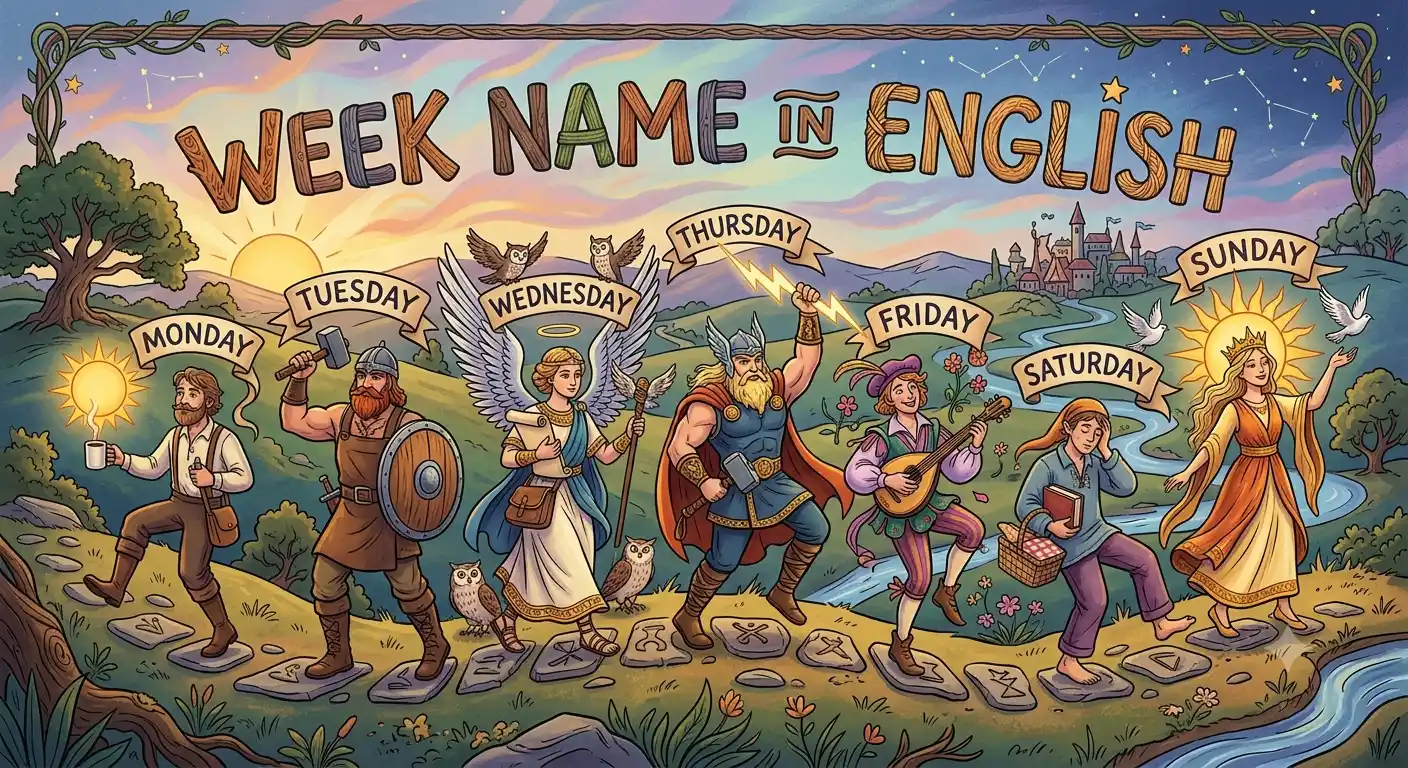
Week Name in English: Days of the Week, Short Forms, Meanings and Examples
If you are learning English, one of the first things to remember is the name of each day. We use the days of the week almost every day—when talking about school, work, appointments, holidays, birthdays, travel plans, and other activities.
There are seven days in a week:
Monday, Tuesday, Wednesday, Thursday, Friday, Saturday, and Sunday.
Here is a simple guide to the week names in English, their short forms, Hindi meanings, and examples.
Days of the Week Name in English
| No. | Day Name | Short Form |
| 1 | Monday | Mon |
| 2 | Tuesday | Tue |
| 3 | Wednesday | Wed |
| 4 | Thursday | Thu |
| 5 | Friday | Fri |
| 6 | Saturday | Sat |
| 7 | Sunday | Sun |
The spelling of Wednesday and Thursday can sometimes be tricky for beginners, so writing and saying the names regularly is a good way to become familiar with them.
Days of the Week Explained
1. Monday
Monday comes after Sunday. For many students and working people, it marks the start of a new school or work week.
Example:
I have an English class on Monday.
2. Tuesday
Tuesday comes after Monday. It is usually a regular school or working day.
Example:
We have a science test on Tuesday.
3. Wednesday
Wednesday falls between Tuesday and Thursday. It is often described as the middle of the working week.
Example:
My music class is on Wednesday.
4. Thursday
Thursday comes after Wednesday and one day before Friday.
Example:
We are going to the library on Thursday.
5. Friday
Friday comes after Thursday. In many schools and workplaces, it is the last regular day before the weekend.
Example:
Our teacher gave us homework on Friday.
6. Saturday
Saturday follows Friday. For many people, it is a day for relaxing, meeting friends, playing sports, shopping, or spending time with family.
Example:
I play cricket with my friends on Saturday.
7. Sunday
Sunday comes after Saturday and is often used as a day for rest or family activities.
Example:
We usually visit our grandparents on Sunday.
Week Name in English with Hindi Meaning
Students who are learning both English and Hindi can use this table to remember the days more easily.
| English Day | Hindi Meaning |
|---|---|
| Monday | सोमवार |
| Tuesday | मंगलवार |
| Wednesday | बुधवार |
| Thursday | गुरुवार |
| Friday | शुक्रवार |
| Saturday | शनिवार |
| Sunday | रविवार |
Short Forms of Days in English
You will often see abbreviated day names on calendars, timetables, apps, notices, and schedules.
| Full Day Name | Short Form |
|---|---|
| Monday | Mon |
| Tuesday | Tue |
| Wednesday | Wed |
| Thursday | Thu |
| Friday | Fri |
| Saturday | Sat |
| Sunday | Sun |
These are common three-letter forms. Some calendars or style guides may use slightly different abbreviations, but the forms above are widely understood.
How to Remember the Days of the Week
The easiest way to learn the days is to say them in order:
Monday → Tuesday → Wednesday → Thursday → Friday → Saturday → Sunday
Try connecting each day with something you normally do. For example:
- Monday – School
- Tuesday – Homework
- Wednesday – Sports
- Thursday – Reading
- Friday – Revision
- Saturday – Games
- Sunday – Family time
You can also write the seven names on paper and say them aloud. After a few days of practice, the order becomes much easier to remember.
Why Are Days of the Week Important?
Knowing the days of the week is useful in everyday English. Children use them to talk about their school timetable, while adults use them for work, appointments, travel, meetings, and other plans.
For example, you might say:
- My exam is on Monday.
- We have a holiday on Friday.
- I will meet my friend on Saturday.
- The shop is closed on Sunday.
Learning these simple sentences can make it easier to talk about your routine and plans in English.
Weekdays and Weekends
The term “weekday” usually refers to Monday through Friday.
Monday, Tuesday, Wednesday, Thursday, and Friday are commonly called weekdays.
Saturday and Sunday are commonly known as the weekend.
The exact working schedule can differ from one country, school, or workplace to another, but these terms are widely used in everyday English.
Frequently Asked Questions
What are the seven days of the week in English?
The seven days are Monday, Tuesday, Wednesday, Thursday, Friday, Saturday, and Sunday.
Which day comes after Monday?
Tuesday comes after Monday.
Which day comes before Friday?
Thursday comes before Friday.
What are the weekend days?
Saturday and Sunday are commonly called the weekend.
How many days are there in a week?
There are seven days in a week.
What is the short form of Wednesday?
The common short form of Wednesday is Wed.
What is the short form of Thursday?
The common short form of Thursday is Thu.
Months’ Names in English
After learning the days of the week, the next useful set of words is the names of the months. A year has twelve months, and we use them when writing dates, talking about birthdays, holidays, seasons, school terms, and important events.
The twelve months are:
January, February, March, April, May, June, July, August, September, October, November, and December.
| No. | Month Name | Short Form |
|---|---|---|
| 1 | January | Jan |
| 2 | February | Feb |
| 3 | March | Mar |
| 4 | April | Apr |
| 5 | May | May |
| 6 | June | Jun |
| 7 | July | Jul |
| 8 | August | Aug |
| 9 | September | Sep |
| 10 | October | Oct |
| 11 | November | Nov |
| 12 | December | Dec |
For example, you could say:
- My birthday is in April.
- The new school term starts in June.
- We usually travel in December.
Learning the days and months together makes it easier to understand calendars and talk about dates in English.
Final Words
The seven days of the week are simple words, but they are used constantly in everyday English. Start by learning them in order, then practice using each one in a short sentence.
Monday, Tuesday, Wednesday, Thursday, Friday, Saturday, Sunday
Once these are familiar, learning the twelve months will make it easier to talk about complete dates, birthdays, holidays, appointments, and other events.
Months Name
Learning the months’ names is an important part of basic education for students. The months are January, February, March, April, May, June, July, August, September, October, November, and December. Understanding the months helps children learn about calendars, dates, seasons, festivals, and special occasions. Students can easily remember the months by practicing them regularly and using a calendar. This simple knowledge builds a strong foundation for time management and everyday communication.