
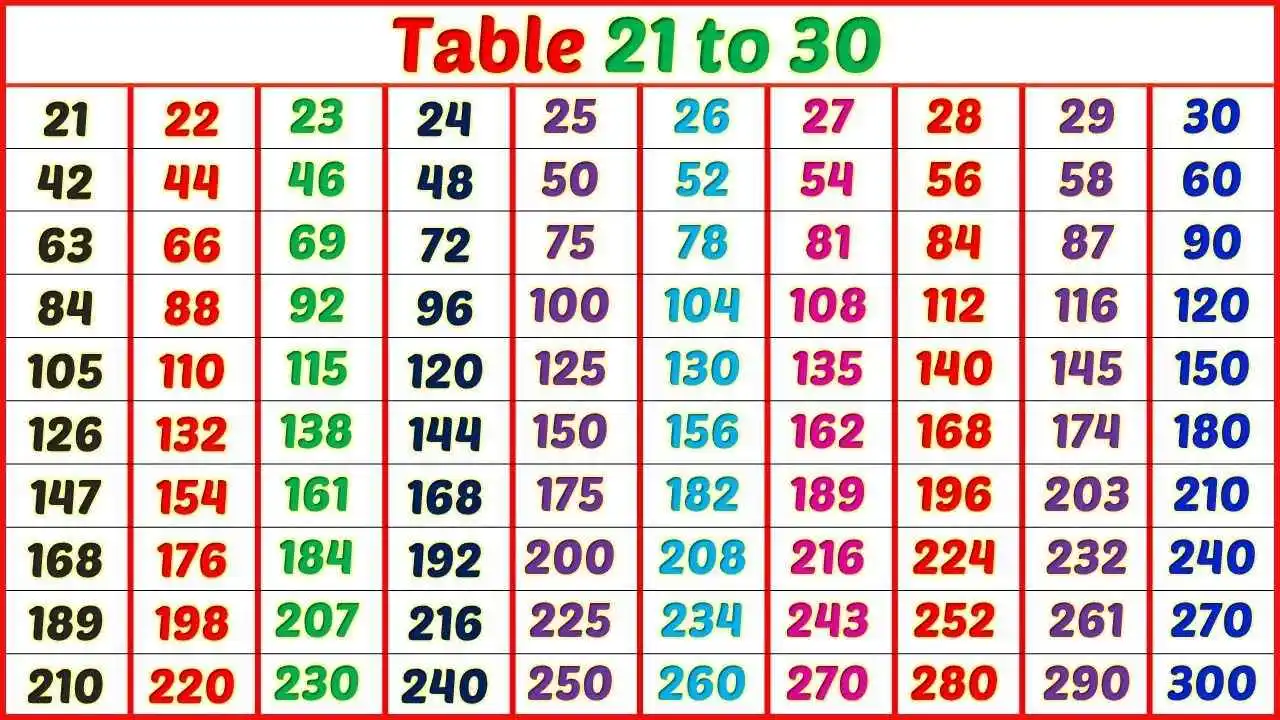
Mastering Multiplication 21 To 30 Tables
Learning the multiplication tables from 21 to 30 helps students develop stronger math skills, making it easier to solve problems involving division, fractions, algebra, and advanced calculations. Knowing these tables by heart can save time and build confidence in both academic and real-life situations.
Many students memorize tables up to 20 in primary grades. As they progress, it is helpful to extend this knowledge through tables 21 to 30 — especially for those preparing for higher-level math, competitive exams, or working on mental arithmetic.
Why Should You Learn 21 To 30 Tables?
While calculators are widely used, relying on them too often can weaken basic calculation abilities. Being able to recall tables 21 to 30 improves:
- Speed in solving problems
- Accuracy in mental math
- Confidence during exams and practical tasks
- Efficiency in day-to-day calculations (such as budgeting, shopping, or fitness tracking)
Memorizing multiplication tables also builds a foundation for understanding patterns in numbers — a key math skill.
Multiplication Tables 21 to 25
| Table of 21 | Table of 22 | Table of 23 | Table of 24 | Table of 25 |
| 21 × 1 = 21 | 22 × 1 = 22 | 23 × 1 = 23 | 24 × 1 = 24 | 25 × 1 = 25 |
| 21 × 2 = 42 | 22 × 2 = 44 | 23 × 2 = 46 | 24 × 2 = 48 | 25 × 2 = 50 |
| 21 × 3 = 63 | 22 × 3 = 66 | 23 × 3 = 69 | 24 × 3 = 72 | 25 × 3 = 75 |
| 21 × 4 = 84 | 22 × 4 = 88 | 23 × 4 = 92 | 24 × 4 = 96 | 25 × 4 = 100 |
| 21 × 5 = 105 | 22 × 5 = 110 | 23 × 5 = 115 | 24 × 5 = 120 | 25 × 5 = 125 |
| 21 × 6 = 126 | 22 × 6 = 132 | 23 × 6 = 138 | 24 × 6 = 144 | 25 × 6 = 150 |
| 21 × 7 = 147 | 22 × 7 = 154 | 23 × 7 = 161 | 24 × 7 = 168 | 25 × 7 = 175 |
| 21 × 8 = 168 | 22 × 8 = 176 | 23 × 8 = 184 | 24 × 8 = 192 | 25 × 8 = 200 |
| 21 × 9 = 189 | 22 × 9 = 198 | 23 × 9 = 207 | 24 × 9 = 216 | 25 × 9 = 225 |
| 21 × 10 = 210 | 22 × 10 = 220 | 23 × 10 = 230 | 24 × 10 = 240 | 25 × 10 = 250 |
Multiplication Tables 26 to 30
| Table of 26 | Table of 27 | Table of 28 | Table of 29 | Table of 30 |
| 26 × 1 = 26 | 27 × 1 = 27 | 28 × 1 = 28 | 29 × 1 = 29 | 30 × 1 = 30 |
| 26 × 2 = 52 | 27 × 2 = 54 | 28 × 2 = 56 | 29 × 2 = 58 | 30 × 2 = 60 |
| 26 × 3 = 78 | 27 × 3 = 81 | 28 × 3 = 84 | 29 × 3 = 87 | 30 × 3 = 90 |
| 26 × 4 = 104 | 27 × 4 = 108 | 28 × 4 = 112 | 29 × 4 = 116 | 30 × 4 = 120 |
| 26 × 5 = 130 | 27 × 5 = 135 | 28 × 5 = 140 | 29 × 5 = 145 | 30 × 5 = 150 |
| 26 × 6 = 156 | 27 × 6 = 162 | 28 × 6 = 168 | 29 × 6 = 174 | 30 × 6 = 180 |
| 26 × 7 = 182 | 27 × 7 = 189 | 28 × 7 = 196 | 29 × 7 = 203 | 30 × 7 = 210 |
| 26 × 8 = 208 | 27 × 8 = 216 | 28 × 8 = 224 | 29 × 8 = 232 | 30 × 8 = 240 |
| 26 × 9 = 234 | 27 × 9 = 243 | 28 × 9 = 252 | 29 × 9 = 261 | 30 × 9 = 270 |
| 26 × 10 = 260 | 27 × 10 = 270 | 28 × 10 = 280 | 29 × 10 = 290 | 30 × 10 = 300 |
How to Memorize Tables 21 to 30
- Use visual aids like charts and posters.
- Practice through daily quizzes or flashcards.
- Look for patterns in the numbers to simplify learning.
- Regular revision helps long-term retention.
- Use apps or online games to make learning fun.
Example Problems Using Tables 21 to 30
Q1: Sam buys 3 boxes of pencils. Each box contains 21 pencils. How many pencils does Sam have in total?
A: 21 × 3 = 63 pencils.
Q2: A person exercises for 2 hours each day for 25 days. How many hours of exercise in total?
A: 2 × 25 = 50 hours.
Q3: A photo frame costs ₹18. What is the price of 10 photo frames?
A: 18 × 10 = ₹180.
Practice Questions
1️⃣ What is the value of 25 × 7?
2️⃣ Solve: 23 × 5 + 100 = ?
3️⃣ Are 24 × 5 and 5 × 24 equal?
4️⃣ What number multiplied by 9 gives 216?
5️⃣ What is 30 × 6?
Frequently Asked Questions
Q1: What do we mean by tables 21 to 30?
A: These are multiplication tables where each number from 21 to 30 is multiplied by natural numbers (1 to 10).
Q2: What is 22 × 8?
A: 22 × 8 = 176.
Q3: What is 25 × 11?
A: 25 × 11 = 275.
Q4: What is 30 × 6?
A: 30 × 6 = 180.
40000 in Words
The number 40000 in words is written as Forty Thousand. Learning how to write numbers in words helps students improve their reading, writing, and mathematical skills. Forty Thousand represents the value of 40,000, where 40 is in the thousands place. It is commonly used in school assignments, exams, banking documents, and everyday calculations. For example, 40,000 can be written on a cheque as Forty Thousand only. Understanding number names makes it easier for students to convert numerical values into words accurately and confidently. Practice writing numbers in words regularly to build a strong foundation in mathematics.