
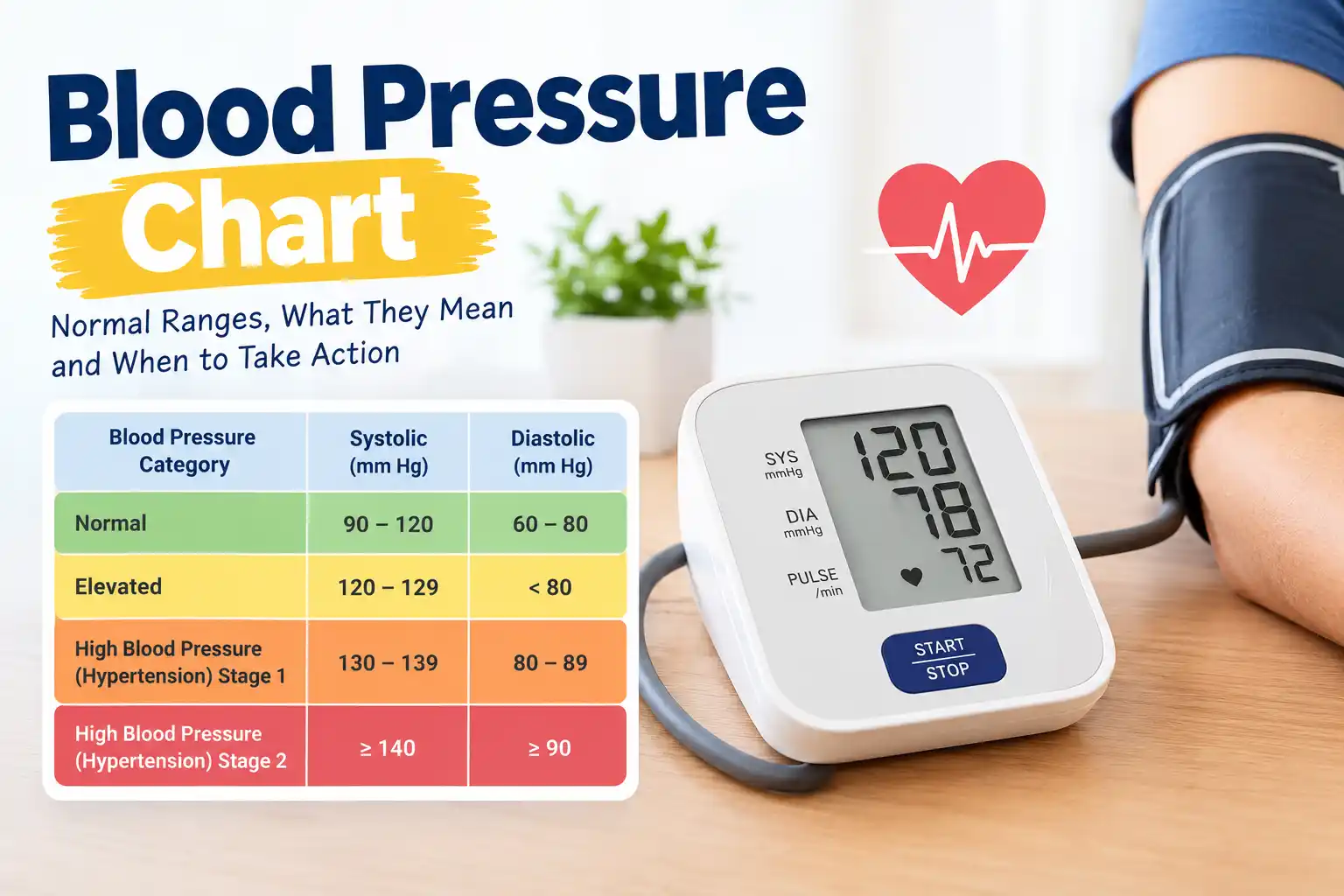
Blood Pressure Chart: Normal, Low, and High Blood Pressure Ranges
Blood pressure is one of the simplest health measurements to take, but the two numbers on a blood pressure monitor can be confusing. Is 120/80 normal? What does 130/80 mean? Is 90/60 too low? And does a person’s age change what is considered a healthy blood pressure?
This blood pressure chart explains the commonly used blood pressure ranges in a simple way. It covers normal, elevated, high, and very high blood pressure, explains systolic and diastolic readings, and shows how to understand a result at home.
For adults, blood pressure is generally classified using the systolic (top) and diastolic (bottom) numbers rather than a separate normal range for every age group. Children and teenagers are different: their blood pressure is interpreted using age, sex, and height because their bodies are still developing.
Important: This page is for educational purposes and is not a diagnosis. A single blood pressure reading does not always tell the whole story. If your readings are repeatedly high or low, discuss them with a qualified healthcare professional.
Blood Pressure Chart for Adults
| Blood Pressure Category | Systolic (Top Number) | Diastolic (Bottom Number) |
| Low blood pressure | Below 90 | or below 60 |
| Normal | Below 120 | and below 80 |
| Elevated | 120–129 | and below 80 |
| Stage 1 hypertension | 130–139 | or 80–89 |
| Stage 2 hypertension | 140 or higher | or 90 or higher |
| Very high / hypertensive crisis range | Higher than 180 | and/or higher than 120 |
The categories above are commonly used for adult blood pressure classification. When the systolic and diastolic numbers fall into different categories, the higher category is generally used for classification.
For example, a reading of 135/76 mm Hg has a systolic number in the Stage 1 range even though the diastolic number is below 80. Likewise, 118/84 mm Hg has a diastolic number in the Stage 1 range.
Blood pressure is measured in millimetres of mercury (mm Hg).
How to Lower Blood Pressure
Learning how to lower blood pressure starts with small, healthy changes in daily life. Eating more fruits, vegetables, whole grains, and other nutritious foods can support healthy blood pressure. Cutting back on salt, processed foods, and sugary drinks may also help. Regular physical activity, such as walking, cycling, or swimming, keeps the heart stronger and supports better circulation. Maintaining a healthy weight, getting enough sleep, and managing stress are also important. Avoiding smoking and limiting alcohol can further protect heart health. If blood pressure remains high, speak with a healthcare professional. They can check your readings and recommend the right treatment.
What Do the Two Blood Pressure Numbers Mean?
A blood pressure reading always has two numbers.
Systolic blood pressure
The systolic number is the top number. It represents the pressure in the arteries when the heart contracts and pumps blood around the body.
For example, in a reading of 120/80 mm Hg, the number 120 is the systolic pressure.
Diastolic blood pressure
The diastolic number is the bottom number. It represents the pressure in the arteries while the heart is relaxing between beats.
In 120/80 mm Hg, the number 80 is the diastolic pressure.
A useful way for students to remember this is
Systolic = pressure when the heart pumps.
Diastolic = pressure when the heart rests between beats
Both numbers matter. Looking only at the top number or only at the bottom number can give an incomplete picture.
What Is a Normal Blood Pressure?
For most adults, a blood pressure below 120/80 mm Hg falls within the normal category.
For example:
- 110/70 – normal
- 115/75 – normal
- 118/78 – normal
- 119/79 – normal
However, a reading being below 120/80 does not automatically mean that every person is healthy in every respect. Blood pressure is only one measurement used when assessing health.
It is also important not to assume that 120/80 is a magic number that everyone must have. Blood pressure naturally changes throughout the day and can be influenced by activity, stress, posture, medications, and other factors.
What Does Elevated Blood Pressure Mean?
Elevated blood pressure refers to a systolic reading of 120 to 129 mm Hg while the diastolic reading remains below 80 mm Hg.
Examples include
- 120/75
- 124/78
- 127/76
- 129/79
Elevated blood pressure is not the same thing as Stage 1 hypertension. It is a signal that the reading is above the normal category and deserves attention, particularly when it occurs repeatedly.
A person should not diagnose themselves from one reading. Tracking measurements over time can provide much more useful information.
What Is Stage 1 Hypertension?
Stage 1 hypertension begins when an adult’s systolic pressure is 130–139 mm Hg or the diastolic pressure is 80–89 mm Hg.
Examples include
- 130/78
- 134/82
- 138/85
- 128/84
Notice that either number can determine the category.
For example, 128/84 has a systolic value below 130, but the diastolic value is 84. Therefore, it falls into the Stage 1 category under the adult classification system.
Repeated readings in this range should be discussed with a healthcare professional, who can consider the person’s overall health and cardiovascular risk.
What Is Stage 2 Hypertension?
Stage 2 hypertension refers to a systolic pressure of 140 mm Hg or higher or a diastolic pressure of 90 mm Hg or higher.
Examples include
- 140/85
- 148/92
- 155/88
- 142/96
A reading does not need to have both numbers above the threshold. If either the systolic or diastolic value reaches the Stage 2 range, the reading is classified accordingly.
Repeated Stage 2 readings warrant medical evaluation. Treatment decisions depend on the individual rather than on the blood pressure number alone.
What Does 180/120 Blood Pressure Mean?
A blood pressure reading above 180 systolic and/or 120 diastolic is in a very high range and should not be ignored.
If a reading reaches this level, repeat the measurement according to proper technique and seek medical guidance promptly.
If very high blood pressure occurs together with symptoms such as chest pain, shortness of breath, weakness or numbness, difficulty speaking, vision changes, or other signs of a serious medical problem, seek emergency medical care immediately.
Do not wait for a blood pressure reading to return to normal on its own when serious symptoms are present.
Blood Pressure Chart by Reading
The following examples can make the categories easier to understand:
| Example Reading | General Adult Category |
| 105/68 | Normal |
| 115/75 | Normal |
| 119/79 | Normal |
| 120/76 | Elevated |
| 125/78 | Elevated |
| 129/79 | Elevated |
| 130/78 | Stage 1 hypertension |
| 135/82 | Stage 1 hypertension |
| 139/89 | Stage 1 hypertension |
| 140/80 | Stage 2 hypertension |
| 150/92 | Stage 2 hypertension |
| 160/100 | Stage 2 hypertension |
| 181/121 | Very high / crisis range |
These examples are intended to explain the classification system, not to diagnose a person.
Is 120/80 a good blood pressure?
A reading of 120/80 mm Hg is commonly described as a healthy reference point, but under the AHA adult categories, the normal category is defined as less than 120 systolic and less than 80 diastolic.
That distinction is important.
For example, 119/79 is within the normal category, whereas a reading of 120/80 reaches the threshold for elevated systolic pressure and Stage 1 diastolic pressure under the category definitions.
This is one reason it is better to look at the complete reading instead of simply memorizing “120/80.”
Is 90/60 low blood pressure?
A blood pressure around 90/60 mm Hg is often considered low or close to the lower end of the adult range.
Low blood pressure is not automatically dangerous. Some people naturally have lower readings and feel perfectly well.
The more important question is whether low blood pressure is accompanied by symptoms.
Possible symptoms can include:
- Dizziness
- Lightheadedness
- Fainting
- Weakness
- Nausea
- Blurred vision
- Confusion in more serious situations
If low readings repeatedly occur or symptoms develop, medical advice is appropriate.
Blood Pressure Chart for Children
Children should not simply be given the same blood pressure chart used for adults.
Blood pressure in children and younger adolescents is interpreted using age, sex, and height. Pediatric guidelines use percentile-based measurements, which means a child’s reading is compared with expected values for children of a similar age, sex, and height.
This is particularly important for students and parents searching for a “normal blood pressure by age” chart.
A number that might be interpreted one way in an adult cannot automatically be interpreted the same way in a young child.
For children and adolescents, a healthcare professional should interpret the reading using an appropriate pediatric reference table.
The American Academy of Pediatrics guideline uses blood pressure percentiles and specific thresholds for elevated blood pressure and hypertension in children and adolescents. For teenagers aged 13 years and older, the guideline also uses thresholds that align more closely with adult categories.
Why Blood Pressure Changes During the Day
Blood pressure is not a fixed number.
It can change depending on what a person is doing and how they are feeling. Physical activity, emotional stress, caffeine, smoking, medications, illness, and even the circumstances in which the measurement is taken can affect the result.
For this reason, one unusually high reading does not necessarily mean that a person has chronic hypertension.
Likewise, one normal reading does not guarantee that blood pressure is always normal.
This is why healthcare professionals may look at repeated measurements rather than relying on one isolated number.
How to Check Blood Pressure Correctly at Home
If you are using a home blood pressure monitor, technique matters.
Before taking a reading:
- Avoid exercise, smoking, and caffeine for about 30 minutes beforehand when possible.
- Empty your bladder.
- Sit quietly for several minutes before measuring.
- Keep your back supported.
- Place both feet flat on the floor.
- Keep your legs uncrossed.
- Rest your arm on a flat surface so the cuff is positioned around heart level.
- Use the correct cuff size.
- Avoid talking while the measurement is being taken.
- Record the result if you are tracking your blood pressure over time.
- A properly positioned and appropriately sized cuff can make a meaningful difference to the quality of a reading.
Why One Blood Pressure Reading May Not Be Enough
Imagine that someone normally has readings around 118/76 but records 145/90 after rushing into an appointment, drinking coffee and sitting down only briefly.
That single number does not automatically prove that the person has persistent hypertension.
The opposite situation can also occur. Someone may have a normal reading during one appointment but regularly experience higher readings at home.
Healthcare professionals therefore consider patterns, repeated measurements and the person’s overall circumstances when evaluating blood pressure.
Some people also experience white-coat hypertension, in which blood pressure is higher in a clinical setting than it is outside the clinic.
Blood Pressure and Age: What Students Should Know
A common search query is “blood pressure chart by age.”
The important point is that there is not one universal adult table saying that a specific blood pressure is normal simply because someone is 30, 40, 50 or 70 years old.
Adult blood pressure categories are generally based on systolic and diastolic thresholds.
Age still matters when a healthcare professional evaluates a person’s overall health, cardiovascular risk and treatment goals. But it should not be used as a shortcut to label a blood pressure reading as healthy or unhealthy.
Children are different because their blood pressure changes as they grow. That is why pediatric charts use age, sex and height.
What Is a Healthy Blood Pressure Goal?
The appropriate blood pressure goal can differ between individuals.
A healthcare professional may consider factors such as:
- Age
- Existing medical conditions
- Cardiovascular risk
- Medications
- Kidney health
- Diabetes
- Previous blood pressure readings
- Whether measurements were taken at home or in a clinic
Therefore, an online chart should be used to understand the terminology, not to replace an individualized medical assessment.
Tips for Keeping Blood Pressure in a Healthy Range
Healthy habits can support cardiovascular health and may help with blood pressure management.
Useful habits include:
Eat a balanced diet
A diet that emphasizes vegetables, fruits, whole grains and other nutritious foods can support overall heart health.
Stay physically active
Regular physical activity is an important part of maintaining cardiovascular fitness.
Be mindful of sodium intake
Many processed and packaged foods contain substantial amounts of sodium. Reading nutrition labels can help people understand how much sodium they are consuming.
Maintain a healthy weight
For people who are above their healthy weight range, weight management may form part of a broader blood pressure strategy.
Avoid smoking
Smoking damages blood vessels and increases cardiovascular risk.
Manage stress
Stress can temporarily influence blood pressure. Finding healthy ways to manage stress can be beneficial for overall well-being.
Take prescribed medicines as directed
People who have been prescribed blood pressure medication should follow their healthcare professional’s instructions rather than changing or stopping medication on their own.
Blood Pressure Chart: Quick Reference
For a quick review, remember these adult categories:
- Normal: below 120/80 mm Hg
- Elevated: systolic 120–129 mm Hg with diastolic below 80 mm Hg
- Stage 1 hypertension: systolic 130–139 mm Hg or diastolic 80–89 mm Hg
- Stage 2 hypertension: systolic 140 mm Hg or higher or diastolic 90 mm Hg or higher
- Very high range: above 180 systolic and/or above 120 diastolic
The higher category applies when the systolic and diastolic values fall into different categories.
Frequently Asked Questions About Blood Pressure
What is a normal blood pressure?
For most adults, normal blood pressure is below 120/80 mm Hg. Both the systolic and diastolic values matter when interpreting the reading.
Is 120/80 normal blood pressure?
120/80 is commonly used as a familiar reference point, but the formal adult categories define normal as below 120 systolic and below 80 diastolic. A reading of 120/80 therefore does not technically fall entirely within the normal category.
Is 130/80 high blood pressure?
Under the commonly used adult classification system, 130/80 falls into Stage 1 hypertension because the systolic value is 130 and the diastolic value is 80.
A single measurement should not be used by itself to diagnose hypertension.
Is 140/90 high blood pressure?
Yes. A reading of 140/90 reaches the Stage 2 hypertension category for adults.
Is 90/60 a normal blood pressure?
90/60 is at the low end of the adult range and may be considered low blood pressure, particularly if the reading is consistently below those levels. Whether it is a problem depends partly on symptoms and the individual’s circumstances.
What is the normal blood pressure for a child?
There is no single normal number that applies to every child. Pediatric blood pressure is interpreted using age, sex and height-based reference values.
Does blood pressure increase with age?
Blood pressure patterns can change as people age, but age alone should not be used to decide whether an adult’s reading is normal. Adult classification is based primarily on systolic and diastolic thresholds.
Which is more important, systolic or diastolic blood pressure?
Both numbers provide useful information. A person can have an elevated systolic reading with a relatively normal diastolic reading, or the reverse. The higher applicable category is generally used when the two values fall into different categories.
How often should I check my blood pressure?
The appropriate frequency depends on your health, previous readings and advice from your healthcare professional. People monitoring blood pressure at home should follow the schedule recommended for their situation.
When is blood pressure an emergency?
A reading above 180 systolic and/or 120 diastolic is very high. If it occurs with symptoms such as chest pain, shortness of breath, weakness, numbness, difficulty speaking or vision changes, seek emergency medical care immediately.
Final Takeaway
A blood pressure reading is more than two numbers on a digital screen. The first number tells you about systolic pressure, while the second represents diastolic pressure. Understanding both makes it easier to interpret a blood pressure chart correctly.
For adults, a reading below 120/80 mm Hg is generally classified as normal, while higher readings move through elevated, Stage 1 and Stage 2 categories. Very high readings require prompt attention, particularly when accompanied by concerning symptoms.
For children, the interpretation is different because age, sex and height are part of the assessment.
Most importantly, do not use an online chart to diagnose yourself or another person. If your readings are repeatedly outside the expected range, keep a record of them and discuss the results with a qualified healthcare professional.
Medical Disclaimer
This article is intended for general educational purposes. It does not provide a diagnosis or replace advice from a doctor or other qualified healthcare professional. Blood pressure targets and treatment decisions can vary between individuals. If you have unusually high or low readings, symptoms, or concerns about your blood pressure, seek appropriate medical advice.