
Child Labour Essay: A Global Challenge Demanding Urgent Action
Child labour constitutes one of the most pervasive violations of fundamental human rights in the contemporary world. Defined by the International Labour Organization (ILO) as work that deprives children of their childhood, interferes with their schooling, and is harmful to their physical, mental, social, or moral development, child labour is a phenomenon deeply rooted in structural inequalities, economic deprivation, and systemic failures in governance and social protection. Unlike light domestic chores or supervised vocational training, exploitative child labour strips millions of young individuals of their right to education, health, and a dignified childhood.
The Global Magnitude of Child Labour
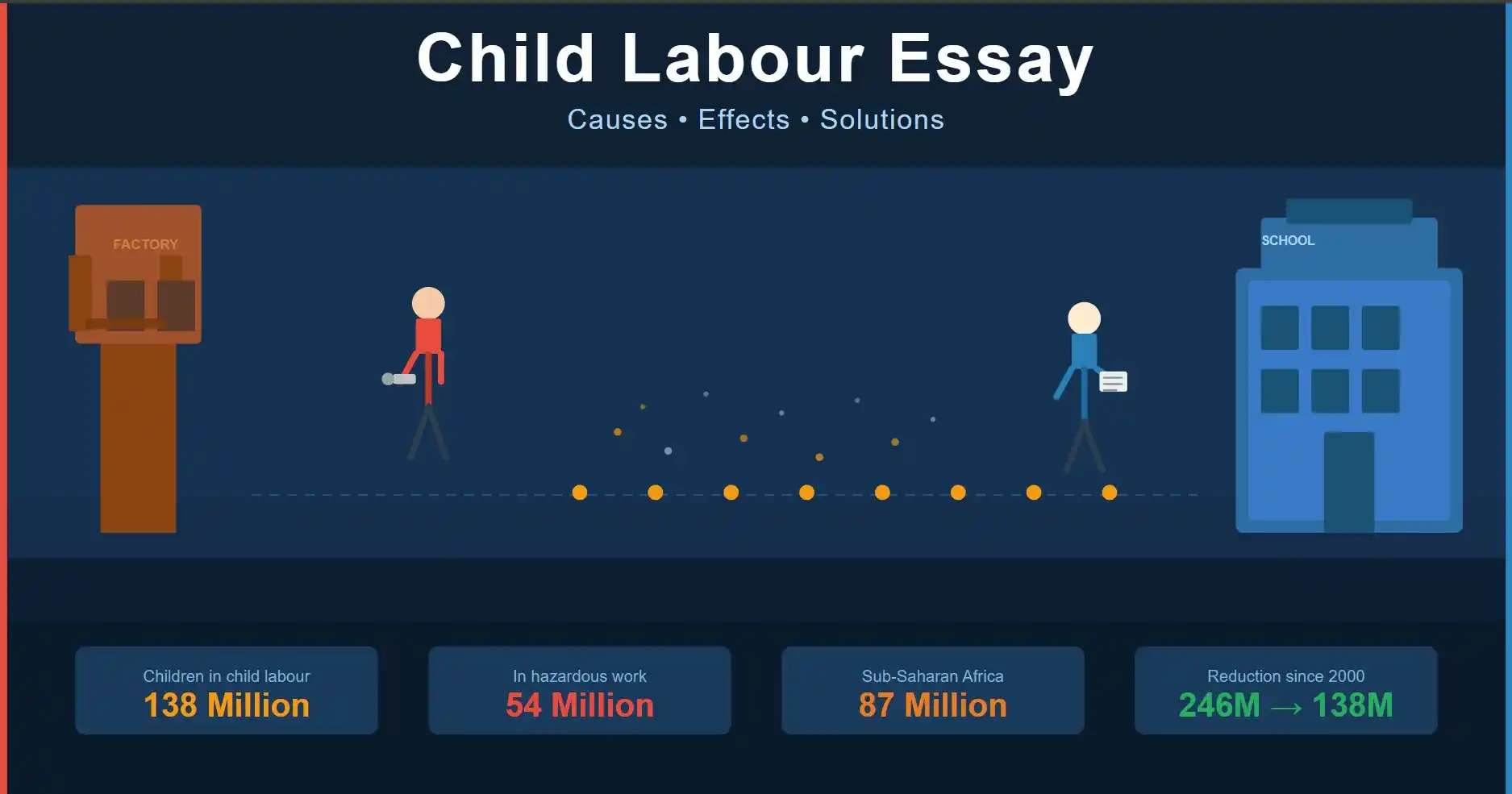
The scale of child labour remains alarming, notwithstanding meaningful progress in recent decades. According to the joint report Child Labour: Global Estimates 2026, Trends and the Road Forward, published by the ILO and UNICEF in June 2025, nearly 138 million children were
engaged in child labour in 2026, including approximately 54 million in hazardous work likely to jeopardize their health, safety, or development.
While this represents a significant improvement — child labour has almost halved since 2000, falling from 246 million to 138 million — the pace of reduction remains critically insufficient. Between 2020 and 2026, child labour prevalence fell by approximately 5.1 percent per year; at that rate, elimination would not be achieved until well after mid-century. Geographically, Sub-Saharan Africa has by far the largest number of children in child labour — 87 million, or close to two-thirds of the global total. Agriculture remains the largest sector, accounting for 61 percent of all cases, followed by services at 27 percent and industry at 13 percent.
Root Causes of Child Labour
A rigorous analysis of child labour necessitates examining its multifaceted causes. Foremost among these is extreme poverty. In households where income is insufficient to meet basic subsistence needs, children are compelled to contribute economically, often at the cost of their education and well-being. The relationship between poverty and child labour is cyclical: children who work instead of attending school are denied the human capital necessary to secure better livelihoods as adults, thereby perpetuating intergenerational poverty.
Inadequate access to quality education is a closely related driver. In many low-income regions, schools are geographically inaccessible, financially prohibitive, or of insufficient quality. Armed conflict and institutional fragility further exacerbate the problem — in countries affected by crisis, the rate of child labour is more than double the global average.
Consequences for Children and Society
The consequences of child labour are profound and multidimensional. At the individual level, children engaged in hazardous work are exposed to serious physical risks, including injury, chronic illness, and developmental impairment. The psychological toll is equally severe: denied the cognitive stimulation of formal education and social development, many child labourers experience lasting emotional and psychological harm.
The most significant long-term effect is the loss of education. Child labour keeps children out of school, fueling intergenerational cycles of poverty and inequality. It weakens economic growth by limiting workforce productivity and innovation, and harms health and well-being both in childhood and later life.
International Legal Frameworks and Policy Responses
The global community has constructed a comprehensive legal architecture to address child labour. The United Nations Convention on the Rights of the Child (UNCRC) enshrines every child’s right to protection from economic exploitation and hazardous work. The ILO’s Convention No. 182 on the Worst Forms of Child Labour has achieved universal ratification among ILO member states — a landmark in international labour law.
In India, the Child Labour (Prohibition and Regulation) Amendment Act of 2016 prohibits the employment of children below the age of 14 in all occupations. Organizations such as UNICEF, Save the Children, and a wide array of civil society actors have advanced rehabilitation programmes, educational outreach, and community-based interventions for affected children.
The Path Forward
Despite progress to eliminate child labour by 2030, the annual pace of reduction would need to be more than 11 times faster than it has been since 2020. Governments must expand social protection programmes, invest in quality education, and strengthen child protection systems.
Child Labour Essay Conclusion
Child labour represents a systemic failure of governance, of economic equity, and of the global commitment to uphold the rights of every child. Ending child labour is not merely a legal or humanitarian obligation; it is a prerequisite for sustainable development, social justice, and the realization of human potential on a global scale.
As scholars, policymakers, and engaged citizens, it is incumbent upon all stakeholders to advocate for a world in which no child is denied their fundamental right to education, safety, and a childhood free from exploitation.
Summer Vacation Essay
Summer vacation is a time of joy and relaxation for students. It’s the perfect opportunity to take a break from studies and enjoy leisure activities. During my summer vacation, I visited my grandparents’ house in the countryside. The peaceful environment and fresh air were refreshing. We explored the nearby lake, went hiking, and had picnics. I also spent time reading my favorite books and playing outdoor games with friends. Summer vacation allowed me to rejuvenate and return to school feeling energized.




[…] Child Labour Essay […]