Python Programming Language Tutorial: Learn Python in 2026
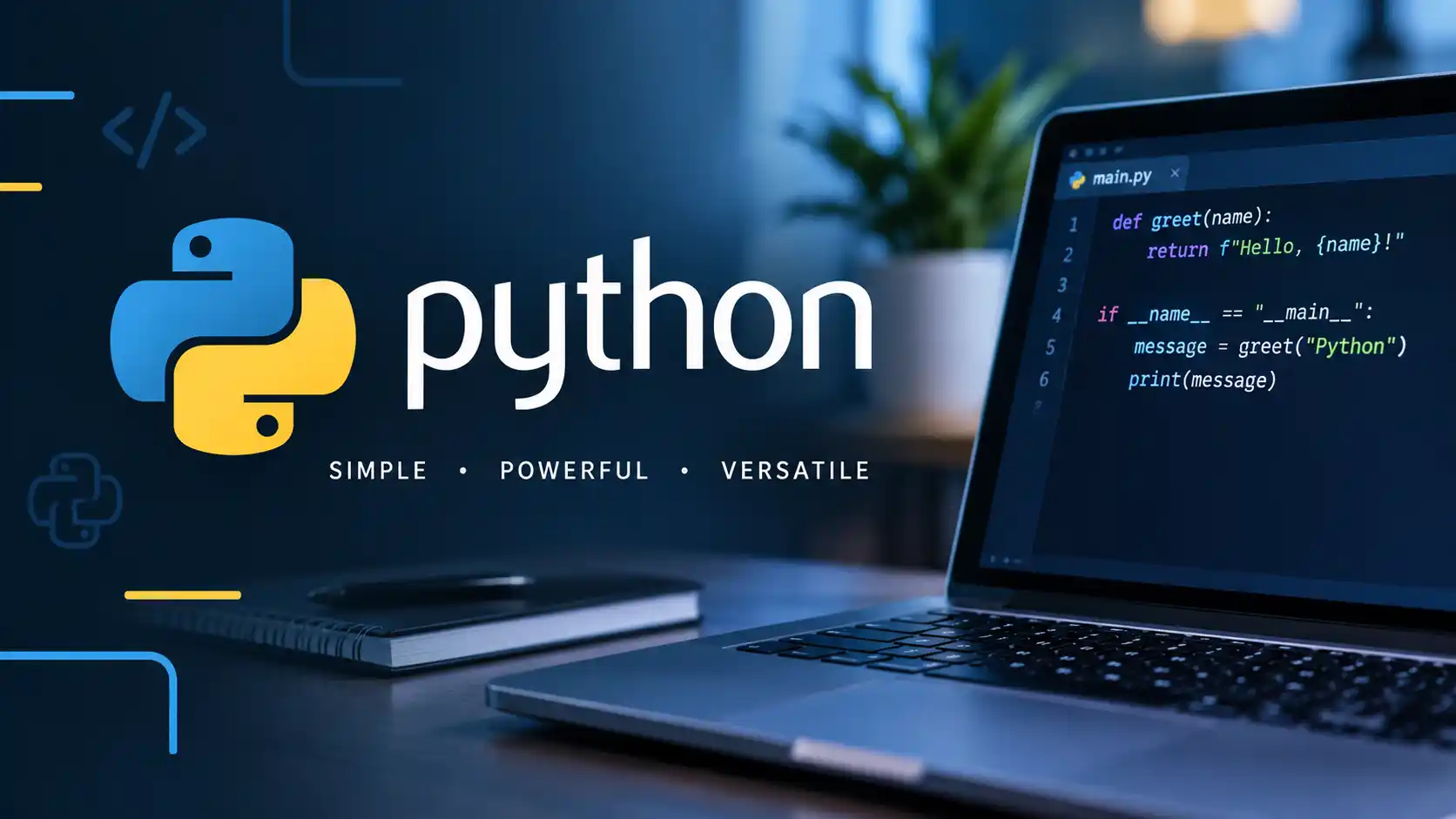
Python is one of the most widely used programming languages in 2025. Its simplicity, readability, and versatility make it ideal for beginners and professionals alike. From web development to AI, Python powers a wide range of applications.
Why Learn the Python Programming Language?
Python stands out among programming languages because it:
- Is easy to learn: Simple syntax that reads like English.
- Boosts productivity: Requires fewer lines of code than Java or C++.
- Supports multiple domains: Web development, AI, machine learning, data analysis, automation, and more.
- Has strong library support: Frameworks like Django, Flask, Pandas, and TensorFlow simplify development.
- Offers job opportunities: Companies like Google, Netflix, and NASA actively hire Python developers.
- Cross-platform: Works on Windows, macOS, and Linux without major changes.
Your First Python Programming Language
Let’s start with a simple program that prints a message:
print("Hello, Python!")
Output:
Hello, Python!
Try changing the text inside the quotes to print your name or a message.
Python Basics
Before diving deeper, you need to understand Python fundamentals:
1. Variables and Data Types
Variables store data, which can be numbers, text, or more complex types.
name = "Alice"
age = 25
is_student = True
2. Input and Output
Get input from the user and display output:
name = input("Enter your name: ")
print(f"Hello, {name}!")
3. Operators
Python supports arithmetic, comparison, and logical operators:
x = 10
y = 5
print(x + y)  # Addition
print(x > y)  # Comparison
print(x and y) # Logical
4. Conditional Statements and Loops
# If-Else
if x > y:
    print("x is greater")
else:
    print("y is greater")

# Loop
for i in range(5):
    print(i)
Python Functions
Functions allow you to reuse code efficiently.
def greet(name):
    return f"Hello, {name}!"

print(greet("Alice"))
Advanced topics include:
- Lambda functions
- *args and **kwargs
- Recursion
- Decorators
- Map, Filter, and Reduce
Python Data Structures
- List: Ordered collection of items
- Tuple: Immutable sequence
- Set: Unordered collection of unique items
- Dictionary: Key-value pairs
fruits = ["apple", "banana", "cherry"]
person = {"name": "Alice", "age": 25}
Python also offers collections modules for advanced structures like Counter and.
Object-Oriented Programming (OOP) in Python
Python supports OOP concepts for modular and reusable code:
- Classes and Objects
- Inheritance and Polymorphism
- Encapsulation and Abstraction
- Iterators and Generators
class Person:
    def __init__(self, name, age):
        self.name = name
        self.age = age

    def greet(self):
        print(f"Hello, I am {self.name}")

p1 = Person("Alice", 25)
p1.greet()
Exception Handling
Python handles errors gracefully using try, and.
try:
    x = 10 / 0
except ZeroDivisionError:
    print("Cannot divide by zero!")
finally:
    print("Execution complete.")
File Handling
Python can read and write files easily:
# Writing to a file
with open("data.txt", "w") as file:
    file.write("Hello, Python!")

# Reading from a file
with open("data.txt", "r") as file:
    print(file.read())
Working with Databases
Python can connect to SQL and NoSQL databases:
- MySQL: Use
mysql-connectororSQLAlchemy - MongoDB: Use
pymongothe library
Python Libraries and Packages
- Web Development: Django, Flask
- Data Analysis: Pandas, NumPy
- Machine Learning: Scikit-learn, TensorFlow, Keras
- Visualization: Matplotlib, Seaborn
- Automation: Selenium, Beautiful Soup
Data Science and AI with Python
Python is the go-to language for data science and AI:
- Foundational Libraries: NumPy, Pandas, Matplotlib
- Statistical Analysis: Seaborn, Statsmodels
- Machine Learning: Scikit-learn, XGBoost, LightGBM
- Deep Learning: TensorFlow, PyTorch, Keras
Web Development with Python
Python frameworks allow you to build dynamic websites and APIs:
- Backend: Django, Flask
- Database Integration: SQLite, SQLAlchemy, Django ORM
- Templates: Jinja2 (Flask), Django Templates
- APIs: Flask-RESTful, Django REST Framework
Applications of Python
Python is used in:
- Web development and APIs
- Data science and analytics
- AI and machine learning
- Scripting and automation
- Web scraping
- Desktop apps and games
Practice and Learning Resources
- Quizzes: Variables, data types, loops, functions
- Coding Exercises: Lists, dictionaries, sets, and advanced structures
- Projects: Build web apps, ML models, and automation scripts
Conclusion:
Python is beginner-friendly, versatile, and in-demand. Mastering Python opens doors to careers in web development, data science, AI, and software engineering.
FAQs – Python Programming
1. What is Python used for?
Python is used in web development, AI, machine learning, data analysis, automation, web scraping, and more.
2. Is Python easy for beginners?
Yes, Python’s simple syntax and readability make it one of the easiest languages to learn.
3. What are Python’s key features?
High-level, readable, cross-platform, versatile, and supported by extensive libraries.
4. Can I build web applications with Python?
Absolutely! Frameworks like Django and Flask make web development simple.
5. Which companies use Python?
Python is used by Google, Netflix, NASA, Instagram, Spotify, and many more.
6. Is Python good for data science and AI?
Yes, Python is the leading language for AI, machine learning, and data analytics.
7. Do I need to know OOP for Python?
While optional at first, OOP knowledge is crucial for building scalable and modular Python applications.
Mastering Excel Formulas for Efficiency
Excel formulas are essential tools for performing calculations, analyzing data, and automating tasks within spreadsheets. Common Excel formulas like SUM, AVERAGE, IF, and VLOOKUP allow users to handle large datasets with ease. By mastering these formulas, you can perform complex mathematical operations, logical comparisons, and data lookups, all while saving time. Excel formulas simplify data management and improve accuracy, making them a must-have skill for professionals in finance, business, and data analysis. Whether for basic calculations or advanced modeling, learning Excel formulas is key to boosting productivity and enhancing your spreadsheet efficiency.
Groovy Language
The Groovy language is a powerful programming language that runs on the Java Virtual Machine (JVM). It was designed to make Java programming simpler, shorter, and more flexible. Groovy supports Java libraries and can work smoothly with existing Java code, making it useful for developers who already know Java. Its easy-to-read syntax also helps beginners understand programming concepts more quickly. Groovy is commonly used for scripting, automation, testing, and building applications. It is especially popular in tools such as Gradle for managing software projects. With features such as dynamic typing, closures, and concise code, Groovy can make everyday programming tasks easier and faster.