
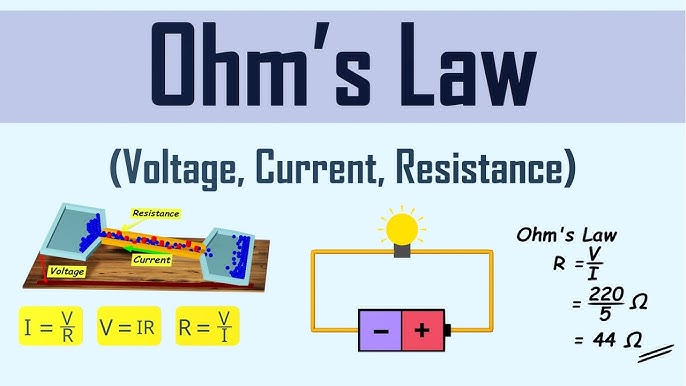
Ohm’s Law: Formula, Definition, Explanation, Applications, and Examples
Ohm’s Law is one of the most fundamental principles in electricity and electronics. It explains the relationship between voltage (V), current (I), and resistance (R) in an electrical circuit. Whether you’re studying physics in school, preparing for competitive exams, or working with electrical circuits, understanding Ohm’s Law is essential.
From charging a smartphone to powering household appliances, the principle behind Ohm’s Law is used in almost every electrical device. It helps engineers design safe electrical systems, enables technicians to troubleshoot circuits, and allows students to solve numerical problems with confidence.
In this guide, you’ll learn everything about Ohm’s Law, including its formula, definition, derivation, practical applications, limitations, solved examples, and frequently asked questions.
What is Ohm’s Law?
Ohm’s Law states that the electric current flowing through a conductor is directly proportional to the voltage applied across it, provided the temperature and other physical conditions remain constant.
In simple words, increasing the voltage increases the current, while increasing the resistance decreases the current.
This relationship helps us understand how electricity flows through wires, resistors, batteries, and electrical appliances.
Definition
German physicist Georg Simon Ohm introduced Ohm’s Law in 1827 after conducting experiments on electrical circuits.
The law can be stated as follows:
At constant temperature, the current passing through a conductor is directly proportional to the potential difference across it and inversely proportional to its resistance.
This principle forms the basis of electrical engineering and circuit analysis.
Ohm’s Law Formula
Where:
- V = Voltage (Volts)
- I = Current (Amperes)
- R = Resistance (Ohms)
From this equation, we can derive two additional formulas:
- Voltage = Current × Resistance
- Resistance = Voltage ÷ Current
These three equations are widely used to solve electrical circuit problems.
Understanding the Three Quantities
Voltage (V)
Voltage is the electrical pressure that pushes electric charges through a circuit. It is measured in volts (V) using a voltmeter.
Example: A standard household battery provides approximately 1.5 volts.
Current (I)
Current is the rate at which electric charge flows through a conductor. It is measured in amperes (A).
A higher current means more electric charge passes through the circuit every second.
Resistance (R)
Resistance is the property of a material that opposes the flow of electric current. It is measured in ohms (Ω).
Materials like copper have low resistance, while rubber and plastic have very high resistance.
How Does Ohm’s Law Work?
Imagine water flowing through a pipe:
- Voltage is like the water pressure.
- Current is like the amount of water flowing.
- Resistance is like the narrowness of the pipe.
If you increase the water pressure, more water flows. If the pipe becomes narrower, less water can pass through. Electrical circuits behave similarly.
Triangle
The Ohm’s Law triangle is a simple memory tool used to remember the relationship between voltage, current, and resistance.
      V
    -----
     I × R
Using this triangle:
- Cover V to get V = I × R
- Cover I to get I = V ÷ R
- Cover R to get R = V ÷ I
This method is especially useful for students during exams.
SI Units Used in Ohm’s Law
| Quantity | Symbol | SI Unit |
|---|---|---|
| Voltage | V | Volt (V) |
| Current | I | Ampere (A) |
| Resistance | R | Ohm (Ω) |
Using the correct SI units ensures accurate calculations in electrical problems.
Why Is Ohm’s Law Important?
Ohm’s Law is one of the most widely used equations in physics and electrical engineering because it helps calculate unknown electrical values quickly. Engineers use it to design safe circuits, electricians rely on it when diagnosing faults, and students use it to solve textbook problems.
Some key benefits include:
- Simplifies electrical calculations.
- Helps design electronic devices.
- Prevents circuit overloads.
- Supports troubleshooting and maintenance.
- Forms the foundation of circuit analysis.
Derivation
Ohm’s Law can be understood by observing how electric current behaves when the voltage across a conductor changes.
Consider a metallic conductor connected to a battery. When a small voltage is applied, only a small amount of current flows through the conductor. As the voltage increases, the electric field inside the conductor becomes stronger, causing more electrons to move. This results in an increase in current.
Experiments show that, for many conducting materials, the ratio of voltage to current remains constant as long as the temperature and other physical conditions do not change. This constant value is known as the resistance of the conductor.
Mathematically,
- Voltage ∝ Current
- Voltage = Current × Resistance
This relationship is known as Ohm’s Law.
Graph
When voltage is plotted on the vertical axis (Y-axis) and current on the horizontal axis (X-axis), the graph forms a straight line passing through the origin.
This straight-line graph indicates that voltage and current are directly proportional. The slope of the graph represents the resistance of the conductor.
Characteristics of the Graph
- Straight line passing through the origin
- Constant slope
- Valid only when temperature remains constant
- A steeper slope indicates higher resistance
Understanding this graph helps students analyze electrical circuits and solve numerical problems more effectively.
Conditions
Ohm’s Law is applicable only under certain conditions. If these conditions are not satisfied, the relationship between voltage and current may no longer remain linear.
The conditions are
- The temperature of the conductor should remain constant.
- The physical dimensions of the conductor should not change.
- The conducting material should remain the same.
- Pressure and environmental conditions should remain unchanged.
If any of these factors vary significantly, resistance may also change, causing deviations from Ohm’s Law.
Ohm’s Law Triangle
Many students find it difficult to remember the three formulas of Ohm’s Law. The Ohm’s Law triangle provides a simple way to recall them during examinations.
        Voltage (V)
       ─────────────
      Current × Resistance
Using this triangle:
- Cover V to get V = I × R
- Cover I to get I = V ÷ R
- Cover R to get R = V ÷ I
This shortcut is widely used in schools and competitive examinations.
Ohm’s Law Formula Wheel
Another useful memory tool is the Ohm’s Law wheel. It combines all related electrical formulas into a single diagram, making it easier to calculate voltage, current, resistance, and electrical power.
Students preparing for board exams often use the formula wheel to revise quickly before examinations.
Practical Applications
Although Ohm’s Law is introduced in classrooms, its applications extend to almost every electrical and electronic device used in daily life.
1. Designing Electrical Circuits
Electrical engineers use Ohm’s Law to determine the correct resistance needed in a circuit. This helps ensure that components receive the appropriate current and voltage.
2. Household Wiring
Electricians apply Ohm’s Law while installing switches, sockets, lighting systems, and protective devices. It helps calculate the current flowing through different appliances and ensures safe wiring.
3. Mobile Phone Chargers
Chargers regulate voltage and current before delivering power to smartphones and other electronic devices. Ohm’s Law plays a key role in this regulation process.
4. LED Lighting Systems
LED bulbs require specific current levels for efficient operation. Resistors are selected using Ohm’s Law to prevent excessive current that could damage the LEDs.
5. Automotive Electronics
Modern vehicles contain numerous electrical systems, including headlights, dashboard displays, sensors, infotainment systems, and battery management units. Engineers use Ohm’s Law when designing and diagnosing these circuits.
6. Industrial Equipment
Factories rely on electrical machines, motors, and control systems that operate within safe electrical limits. Ohm’s Law helps determine the correct electrical parameters for reliable operation.
Advantages
Ohm’s Law remains one of the most important principles in electrical engineering because it offers several practical benefits.
- Makes circuit calculations simple and accurate.
- Helps determine unknown electrical values.
- Forms the basis of electrical engineering.
- Assists in troubleshooting faulty circuits.
- Supports the design of safe electrical systems.
- Essential for students preparing for competitive examinations.
Limitations
Although Ohm’s Law is extremely useful, it cannot be applied universally.
Some limitations include the following:
Temperature Changes
Resistance changes with temperature. If the conductor becomes significantly hotter, the simple voltage-current relationship may no longer remain valid.
Non-Ohmic Devices
Certain electronic components do not obey Ohm’s Law because their resistance changes with voltage or current.
Examples include:
- Diodes
- Transistors
- Thermistors
- Filament lamps
- Solar cells
- LEDs
Electrolytes
Solutions that conduct electricity through ions often do not follow Ohm’s Law under all operating conditions.
Gas Discharge Tubes
Devices such as neon lamps exhibit nonlinear electrical behavior and therefore do not satisfy Ohm’s Law throughout their operating range.
Solved Examples
Example 1
A resistor has a resistance of 5 Ω and is connected to a 10 V battery.
Find the current.
Given:
Voltage = 10 V
Resistance = 5 Ω
Using Ohm’s Law:
Current = Voltage ÷ Resistance
Current = 10 ÷ 5
Answer:
Current = 2 A
Example 2
A circuit carries 4 A of current through a 3 Ω resistor.
Find the voltage.
Given:
Current = 4 A
Resistance = 3 Ω
Voltage = Current × Resistance
Voltage = 4 × 3
Answer:
Voltage = 12 V
Example 3
A battery supplies 24 V while the current flowing through a conductor is 6 A.
Find the resistance.
Resistance = Voltage ÷ Current
Resistance = 24 ÷ 6
Answer:
Resistance = 4 Ω
Real-Life Example
Imagine connecting a small LED bulb to a battery without a resistor. Because the resistance is very low, excessive current may flow through the LED, causing it to burn out.
Adding an appropriate resistor limits the current to a safe value, allowing the LED to operate efficiently. This simple example demonstrates why Ohm’s Law is essential in electronic circuit design.
Common Mistakes Students Should Avoid
While solving problems, students often make avoidable errors. Keep these points in mind:
- Always write the correct SI units before solving.
- Convert values into standard units if necessary.
- Use the appropriate formula based on the quantity to be found.
- Read the question carefully to identify the given values.
- Avoid rounding intermediate calculations too early.
Following these tips can improve accuracy and help score better marks in examinations.
Bodmas Questions
BODMAS Questions help students learn the correct order of mathematical operations through simple and practical practice problems. Solving BODMAS questions regularly improves calculation speed, reduces common mistakes, and builds confidence in arithmetic. This collection includes easy, moderate, and challenging questions with clear step-by-step answers, making it suitable for students of all learning levels. Whether you are preparing for school exams, competitive tests, or daily math practice, these BODMAS exercises strengthen your problem-solving skills. Practice consistently to understand brackets, order of operations, division, multiplication, addition, and subtraction, and develop a strong foundation in mathematics with confidence.