Ganesh Chaturthi: History, Significance, Puja, Celebrations and Visarjan
Ganesh Chaturthi is one of the most loved Hindu festivals in India. The festival is dedicated to Lord Ganesha, who is traditionally worshipped as the remover of obstacles, the deity associated with wisdom and a symbol of auspicious beginnings.
For many families, Ganesh Chaturthi is not simply a day of worship. It is a time when relatives come together, homes are decorated, prayers are offered, sweets are prepared and communities celebrate together. In different parts of India, the festival has its own traditions, names and styles of celebration.
Ganesh Chaturthi is also known as Vinayaka Chaturthi, Vinayaka Chavithi, Ganeshotsav and Ganesh Chavithi in different regions.
The festival begins with the installation of a Ganesha idol and continues with daily prayers and cultural activities. Depending on local tradition, families and communities may keep the idol for different numbers of days before performing Ganesh Visarjan.
When Is Ganesh Chaturthi Celebrated?
Ganesh Chaturthi is observed on the Chaturthi, or fourth lunar day, of the Shukla Paksha in the Hindu month of Bhadrapada. Because the Hindu calendar follows lunar cycles, the festival falls on different dates in the Gregorian calendar each year.
In 2026, Ganesh Chaturthi falls on Monday, September 14.
The festival period commonly continues for several days and reaches a major conclusion on Anant Chaturdashi, when many public celebrations culminate in Ganesh Visarjan.
The exact puja and Visarjan timings can differ according to the city and local Panchang. Anyone planning a ceremony should therefore check the timings applicable to their location rather than relying on a single nationwide clock time.
What Is Ganesh Chaturthi?
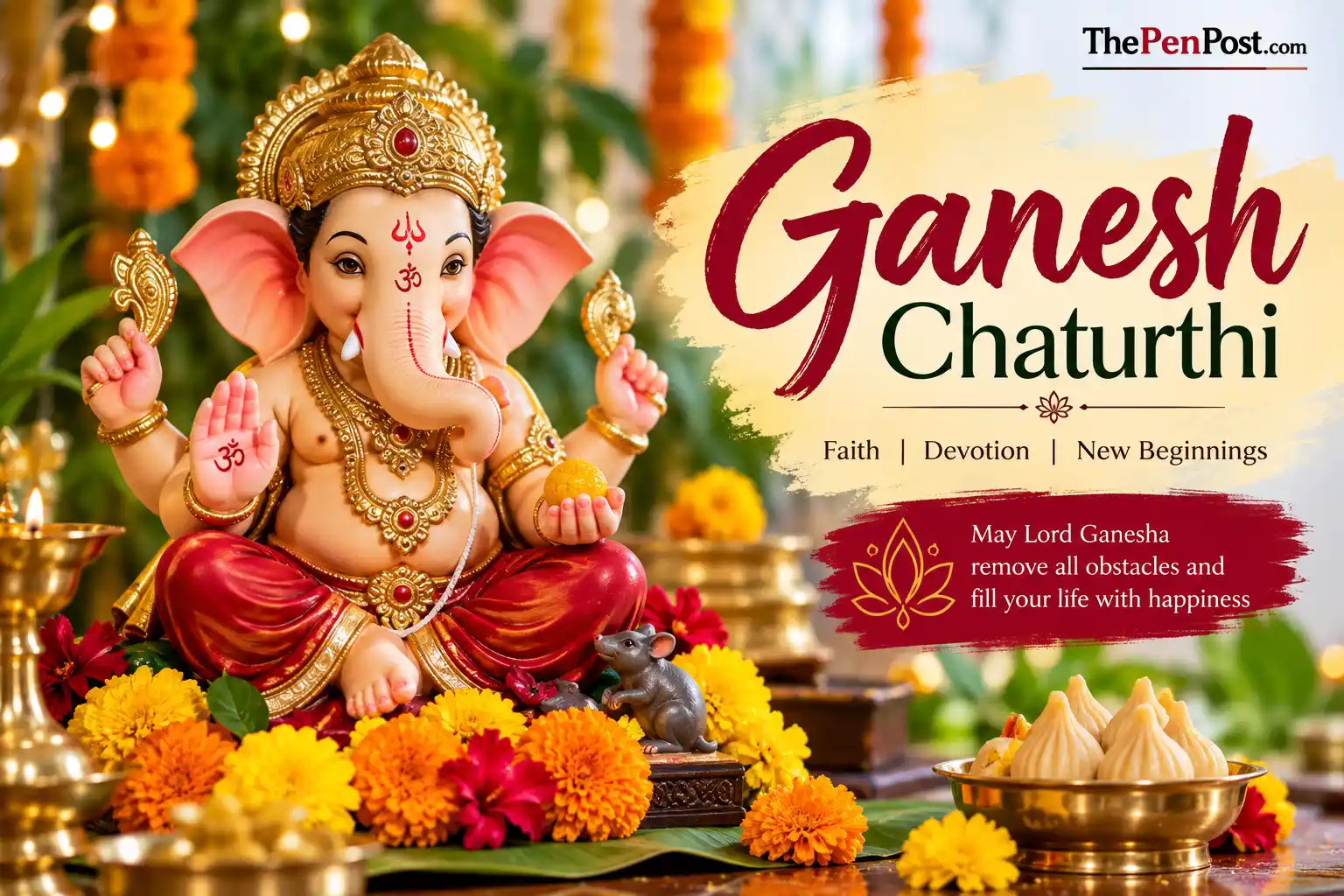
Devotees install an idol or murti of Ganesha and perform prayers, offerings and aarti during the festival.
Lord Ganesha is widely known by names such as Ganapati, Vinayaka, Vighnaharta and Ekdanta. He is traditionally worshipped before beginning important activities because devotees seek his blessings for wisdom, success and freedom from obstacles.
Why Is Ganesh Chaturthi Important?
The importance of Ganesh Chaturthi comes from both its religious meaning and its cultural role.
For devotees, Lord Ganesha represents wisdom, learning, good fortune and auspicious beginnings.
The festival also brings families and communities together. People who may not meet regularly often participate in prayers, meals, cultural programmes and neighbourhood celebrations during Ganeshotsav.
Ganesh Chaturthi has another important dimension in modern India: environmental awareness. The choice of materials used for idols and the way immersion is carried out can affect local water bodies. This has encouraged many families and community groups to choose natural clay idols and more environmentally responsible celebration methods.
History of Ganesh Chaturthi
Worship of Lord Ganesha is much older than the modern public Ganesh festival. Ganesha has been an important figure in Hindu religious traditions for centuries.
The form of Ganesh Chaturthi celebrated today, particularly the large public festival, has an important connection with Maharashtra.
During the late nineteenth century, Bal Gangadhar Tilak helped transform Ganesh worship into a large public celebration. Public Ganesh festivals created an opportunity for people from different sections of society to gather together.
The public celebration became especially influential during India’s freedom movement, when community festivals could encourage social unity.
Pune also has an important place in the history of public Ganeshotsav. The tradition later spread widely, and today large-scale Ganesh celebrations can be seen in many parts of India.
It is useful to distinguish between the ancient religious tradition of worshipping Ganesha and the later development of the large public festival. They are related, but they are not exactly the same historical phenomenon.
The Story of Lord Ganesha
Several traditional stories describe the origin and life of Lord Ganesha. One of the best-known stories is connected with Goddess Parvati and Lord Shiva.
According to a popular version of the story, Parvati created Ganesha and asked him to guard the entrance while she was bathing. When Shiva returned and attempted to enter, Ganesha stopped him because he was following his mother’s instructions.
A confrontation followed, and Ganesha was eventually killed by Shiva. Parvati was deeply distressed, and Shiva promised to restore Ganesha’s life.
An elephant’s head was placed on Ganesha’s body, and he was brought back to life. Shiva then accepted Ganesha as his son and gave him an honoured place among the gods.
Different Hindu texts and regional traditions tell the story with variations. Therefore, the details may differ from one retelling to another.
Lord Ganesha’s Symbolism
The appearance of Lord Ganesha carries several symbolic meanings.
Elephant Head
The elephant head is often associated with wisdom, strength and intelligence.
Large Ears
Ganesha’s large ears are commonly interpreted as a reminder to listen carefully and distinguish useful knowledge from unnecessary noise.
Trunk
The trunk represents strength as well as adaptability. An elephant’s trunk can perform both powerful and delicate tasks, making it a useful symbol of flexibility.
Large Belly
Ganesha’s large belly is often interpreted as the ability to accept and digest the experiences of life.
Mouse as His Vehicle
Ganesha is traditionally shown with a mouse or rat as his vehicle, known as Mushika. The pairing is often interpreted symbolically, with different traditions offering different explanations.
These interpretations are part of religious and cultural symbolism rather than scientific descriptions.
How Is Ganesh Chaturthi Celebrated?
Ganesh Chaturthi celebrations vary from one family and region to another, but several traditions are common.
1. Bringing Home the Ganesha Idol
Families select a Ganesha murti and bring it home on the day of installation. Some choose a small clay idol, while larger community celebrations may have much bigger murtis.
2. Ganesh Sthapana
The idol is placed in a decorated area or temporary shrine. The family then performs the traditional installation and worship according to its custom.
3. Daily Puja
During the period for which the idol is kept, devotees may perform daily prayers, offer flowers and other items, chant devotional verses and perform aarti.
4. Offering Modak
Modak is one of the sweets most closely associated with Lord Ganesha. Families prepare or purchase different varieties of modak during Ganesh Chaturthi.
5. Offering Durva Grass
Durva, a type of sacred grass, is traditionally offered to Ganesha during worship.
6. Community Celebrations
Public pandals may organize aarti, cultural programmes, devotional music, competitions and community meals.
7. Ganesh Visarjan
At the end of the family’s chosen celebration period, the Ganesha idol is carried in a procession and immersed according to local tradition.
Ganesh Chaturthi Puja Items
The exact list can vary by family tradition, but commonly used items may include:
- Ganesha idol
- Flowers
- Durva grass
- Kumkum
- Chandan or sandalwood paste
- Rice or akshata
- Incense
- Diya
- Fruits
- Modak or other sweets
- Water
- Coconut
- Betel leaves and nuts
- Kalash
- Puja cloth
Not every household uses exactly the same items. Religious practices often vary by region, family and sampradaya.
Simple Ganesh Chaturthi Puja Steps
A basic home celebration can follow the family’s traditional method.
Step 1: Clean the Puja Area
Clean the place where the Ganesha idol will be installed and decorate it according to your preference.
Step 2: Place the Idol
Keep the idol respectfully on a clean platform or decorated altar.
Step 3: Begin the Puja
Light a diya and incense and begin the prayer according to your family’s tradition.
Step 4: Offer Puja Materials
Offer flowers, durva, kumkum, sandalwood paste, fruits and sweets as appropriate.
Step 5: Offer Modak
Modak is traditionally associated with Ganesha and is commonly included as an offering.
Step 6: Perform Aarti
Complete the worship with Ganesha aarti and prayers.
Step 7: Distribute Prasad
After the puja, the offerings can be distributed as prasad among family members and guests.
People following a specific religious tradition should use the puja method recommended by their family priest or trusted religious authority.
Ganesh Visarjan
Ganesh Visarjan is the ritual immersion of the Ganesha idol after the period of worship.
It carries an important symbolic message. The idol that was welcomed into the home or community is eventually returned to nature through immersion.
The farewell can be emotional. Devotees often carry the idol in a procession while singing devotional songs and chanting “Ganpati Bappa Morya.”
Some families perform Visarjan after one and a half days, while others keep the idol for three, five, seven, ten or other traditionally observed periods.
The final major day of the traditional festival is associated with Anant Chaturdashi.
Eco-Friendly Ganesh Chaturthi
Environmental responsibility has become an important part of modern Ganesh Chaturthi discussions.
Families and organizers can also reduce environmental impact by:
- Choosing natural clay idols
- Using biodegradable decorations
- Avoiding excessive plastic decoration
- Reusing decorative materials
- Keeping sound levels within local regulations
- Using designated artificial immersion tanks where available
- Following local municipal instructions for Visarjan
Celebrating responsibly does not mean reducing devotion. It can be a way of respecting both religious traditions and the environment.
Ganesh Chaturthi Celebrations in Different Parts of India
Ganesh Chaturthi is celebrated throughout India, but some regions are especially well known for their distinctive traditions.
Maharashtra
Maharashtra is famous for large public Ganeshotsav celebrations. Cities such as Mumbai and Pune host numerous public pandals, cultural events and processions.
Telangana
Ganesh Chaturthi is celebrated enthusiastically across Telangana. Hyderabad is particularly known for its large public Ganesha idols and processions. The Khairatabad Ganesh has become one of the most recognizable examples of a large public Ganesha celebration.
Andhra Pradesh
The festival is commonly known as Vinayaka Chavithi in Telugu-speaking regions. Families and communities perform puja, prepare traditional offerings and organize Visarjan.
Karnataka
Karnataka celebrates Ganesh Chaturthi in homes, temples and public spaces.
Goa
Ganesh Chaturthi is an important family and community festival in Goa, with traditional celebrations continuing across generations.
The style of celebration can vary considerably even within the same state.
Ganesh Chaturthi and Students
Ganesh Chaturthi is an excellent topic for students because it connects history, culture, language and environmental awareness.
Students can learn about:
- The history of Ganeshotsav
- The symbolism of Lord Ganesha
- Indian festivals
- Regional traditions
- Traditional food
- Environmental responsibility
- Community participation
- Indian cultural heritage
A school project can include a short history, pictures, traditional foods, regional celebrations and information about eco-friendly Visarjan.
Short Ganesh Chaturthi Essay
Ganesh Chaturthi is an important Hindu festival celebrated in honour of Lord Ganesha. It is observed on the fourth day of the Shukla Paksha in the Hindu month of Bhadrapada. Devotees bring Ganesha idols into their homes and public pandals, perform prayers and offer sweets such as modak.
The festival is celebrated with great enthusiasm in Maharashtra, Telangana, Andhra Pradesh, Karnataka, Goa and many other parts of India. Public Ganeshotsav also has an important place in India’s cultural history.
After the period of worship, devotees perform Ganesh Visarjan. Today, many people are also choosing eco-friendly idols and decorations to reduce the environmental impact of the celebrations.
Ganesh Chaturthi teaches values such as devotion, wisdom, community participation and respect for nature. It is therefore both a religious festival and an important part of India’s cultural heritage.
Ganesh Chaturthi Wishes
Here are a few simple wishes suitable for sharing with friends and family:
Happy Ganesh Chaturthi! May Lord Ganesha bless you and your family with happiness, wisdom and prosperity.
May Ganpati Bappa remove obstacles from your path and bring peace and positivity into your life. Happy Ganesh Chaturthi!
Wishing you and your family a joyful and blessed Ganesh Chaturthi. Ganpati Bappa Morya!
Frequently Asked Questions About Ganesh Chaturthi
When is Ganesh Chaturthi celebrated?
Ganesh Chaturthi is celebrated on the fourth day of the Shukla Paksha in the Hindu month of Bhadrapada. The Gregorian calendar date changes every year.
When is Ganesh Chaturthi in 2026?
Ganesh Chaturthi will be observed on Monday, September 14, 2026. Local Panchang calculations should be checked for exact puja timings.
What is Ganesh Chaturthi?
Ganesh Chaturthi is a Hindu festival dedicated to Lord Ganesha. It is traditionally associated with his birth and is celebrated through idol installation, prayers, offerings, aarti and Visarjan.
Why do we celebrate Ganesh Chaturthi?
Devotees celebrate Ganesh Chaturthi to honour Lord Ganesha, who is traditionally worshipped as the remover of obstacles and associated with wisdom, learning and auspicious beginnings.
How many days is Ganesh Chaturthi celebrated?
The duration varies. Some families perform Visarjan after a short period, while others observe the festival for several days, with major public celebrations traditionally extending toward Anant Chaturdashi.
What is Ganesh Visarjan?
Ganesh Visarjan is the ritual immersion of the Ganesha idol at the end of the worship period. It symbolizes the return of the deity’s physical form to nature.
Which sweet is offered to Lord Ganesha?
Modak is one of the most commonly associated offerings made to Lord Ganesha during Ganesh Chaturthi.
What is Ganesh Chaturthi called in Telugu?
In Telugu-speaking regions, the festival is commonly known as Vinayaka Chavithi.
Why is Ganesh Chaturthi important for students?
Lord Ganesha is traditionally associated with wisdom and learning. The festival also gives students an opportunity to learn about Indian history, culture, traditions and environmental responsibility.
How can Ganesh Chaturthi be celebrated in an eco-friendly way?
Using natural clay idols, biodegradable decorations, reducing plastic use and following designated immersion facilities are some ways to make the celebration more environmentally responsible.
Conclusion
Ganesh Chaturthi is much more than the installation and immersion of a Ganesha idol. It brings together devotion, family traditions, community participation, history, art and culture.
For devotees, it is a time to seek Lord Ganesha’s blessings for wisdom, happiness and the removal of obstacles.
As celebrations continue to evolve, eco-friendly practices can help preserve the joy of the festival while reducing its impact on the environment.
Whether celebrated quietly at home or through a large community Ganeshotsav, the central spirit remains the same: faith, togetherness, wisdom and a positive beginning.
Ganpati Bappa Morya!
Vinayaka Chavithi Katha in Telugu
వినాయక చవితి రోజున ప్రతి ఇంట్లో భక్తిశ్రద్ధలతో గణపతి పూజ చేస్తారు. ఈ పూజలో వినాయక చవితి కథను చదవడం లేదా వినడం ముఖ్యమైన ఆచారంగా భావిస్తారు. వినాయకుడి జననం, ఆయన గొప్పతనం, భక్తులపై చూపే కరుణను ఈ కథ వివరిస్తుంది. వినాయక చవితి కథను తెలుగులో సులభంగా చదివి, పిల్లలు కూడా పూజా విధానాన్ని మరియు పండుగ ప్రాముఖ్యతను అర్థం చేసుకోవచ్చు. పూజ సమయంలో కుటుంబ సభ్యులు కలిసి కథను చదవడం వల్ల ఆధ్యాత్మిక వాతావరణం ఏర్పడుతుంది. వినాయకుడిని జ్ఞానం, విజయానికి ప్రతీకగా భావిస్తారు. అందుకే విద్యార్థులు కూడా వినాయక చవితి రోజున ఆయనను భక్తితో పూజించి, తమ చదువులో మంచి ఫలితాలు రావాలని కోరుకుంటారు. ఈ కథ పండుగ వెనుక ఉన్న విశ్వాసాలను తెలుసుకోవడానికి ఉపయోగపడుతుంది.