
Cube Root 1 to 30: Complete Table, Values, Methods, and Examples
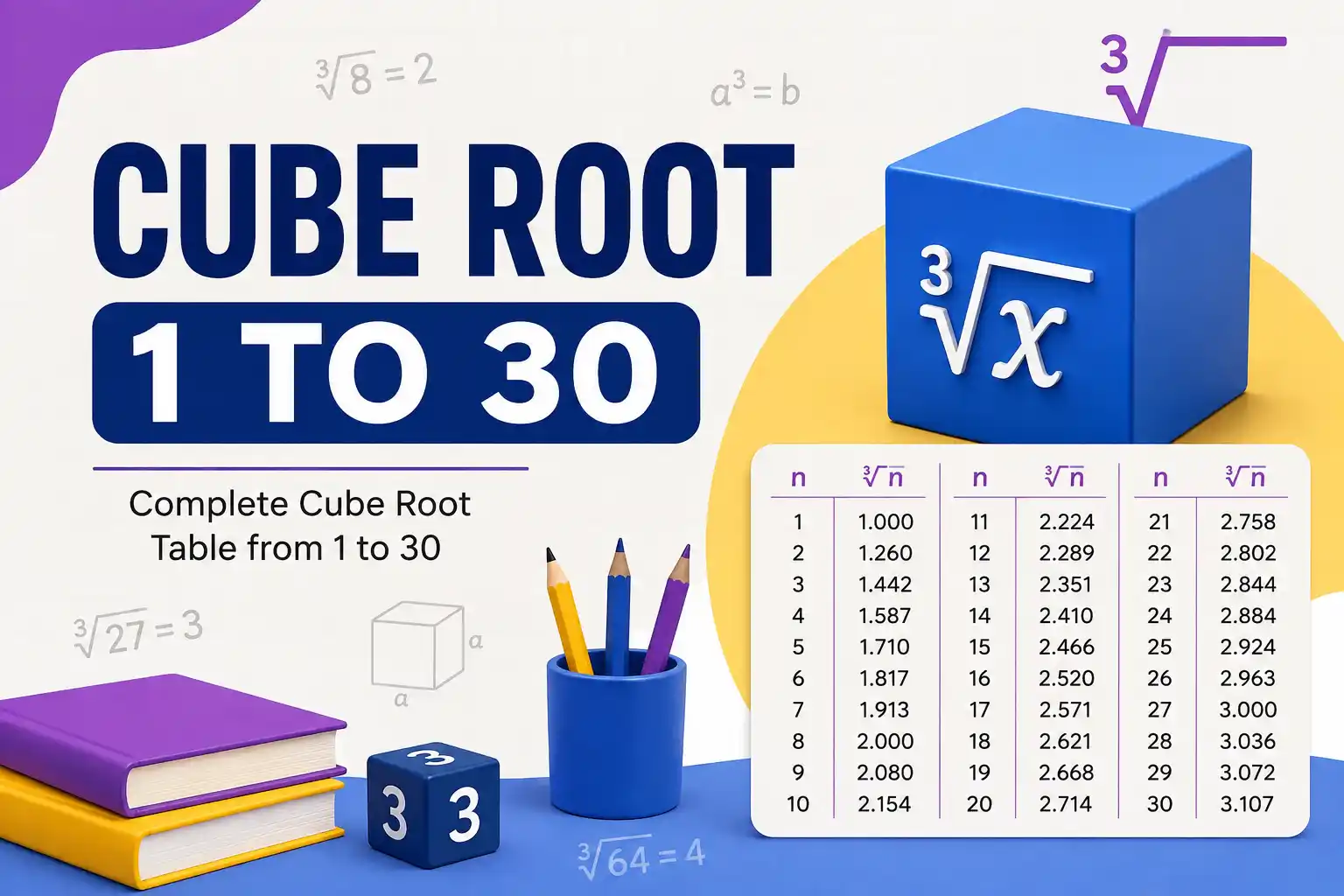
Finding the cube root of a number becomes much easier when you know the basic cube root values and understand how cubes are formed. The cube root 1 to 30 table is especially useful for students learning square roots, cube roots, exponents, and number patterns.
In this guide, you will find the cube roots of numbers from 1 to 30, a separate list of perfect cubes, simple methods for finding cube roots, examples, and frequently asked questions. The table is designed for quick revision and can be useful for school homework, tests, and competitive exam preparation.
Cube Root 1 to 30 Table
The cube root of a number is the value that, when multiplied by itself three times, gives the original number.
For example, 3 × 3 × 3 = 27, so the cube root of 27 is 3.
Here is the complete cube root table from 1 to 30:
| Number | Cube Root |
| 1 | 1 |
| 2 | ∛2 ≈ 1.260 |
| 3 | ∛3 ≈ 1.442 |
| 4 | ∛4 ≈ 1.587 |
| 5 | ∛5 ≈ 1.710 |
| 6 | ∛6 ≈ 1.817 |
| 7 | ∛7 ≈ 1.913 |
| 8 | 2 |
| 9 | ∛9 ≈ 2.080 |
| 10 | ∛10 ≈ 2.154 |
| 11 | ∛11 ≈ 2.224 |
| 12 | ∛12 ≈ 2.289 |
| 13 | ∛13 ≈ 2.351 |
| 14 | ∛14 ≈ 2.410 |
| 15 | ∛15 ≈ 2.466 |
| 16 | ∛16 ≈ 2.520 |
| 17 | ∛17 ≈ 2.571 |
| 18 | ∛18 ≈ 2.621 |
| 19 | ∛19 ≈ 2.668 |
| 20 | ∛20 ≈ 2.714 |
| 21 | ∛21 ≈ 2.759 |
| 22 | ∛22 ≈ 2.802 |
| 23 | ∛23 ≈ 2.844 |
| 24 | ∛24 ≈ 2.884 |
| 25 | ∛25 ≈ 2.924 |
| 26 | ∛26 ≈ 2.962 |
| 27 | 3 |
| 28 | ∛28 ≈ 3.037 |
| 29 | ∛29 ≈ 3.072 |
| 30 | ∛30 ≈ 3.107 |
Perfect cube numbers between 1 and 30
There are only three perfect cubes from 1 to 30:
- 1 = 1³, so ∛1 = 1
- 8 = 2³, so ∛8 = 2
- 27 = 3³, so ∛27 = 3
The other numbers in the range do not have whole-number cube roots.
What Is a Cube Root?
A cube root is the number that produces a given number when it is multiplied by itself three times.
In simple terms:
a × a × a = b
Then a is the cube root of b.
For example:
4 × 4 × 4 = 64
Therefore:
∛64 = 4
The symbol ∛ is called the cube root symbol or radical symbol with an index of three.
What Does ∛27 Mean?
The expression ∛27 asks:
Which number multiplied by itself three times gives 27?
Since:
3 × 3 × 3 = 27
We get:
∛27 = 3
Similarly:
2 × 2 × 2 = 8
Therefore:
∛8 = 2
Cubes of Numbers from 1 to 10
Learning the cubes of small numbers makes finding cube roots much easier.
| Number | Cube |
|---|---|
| 1 | 1 |
| 2 | 8 |
| 3 | 27 |
| 4 | 64 |
| 5 | 125 |
| 6 | 216 |
| 7 | 343 |
| 8 | 512 |
| 9 | 729 |
| 10 | 1000 |
These values are worth memorising because they frequently appear in mathematics problems.
For instance, if a question asks for the cube root of 125, you can immediately identify that:
5³ = 125
Therefore:
∛125 = 5
How to Find the Cube Root of a Perfect Cube
The easiest way to find the cube root of a perfect cube is to identify the number that has been multiplied three times.
Example 1: Find ∛8
We know:
2 × 2 × 2 = 8
Therefore:
∛8 = 2
Example 2: Find ∛27
We know:
3 × 3 × 3 = 27
Therefore:
∛27 = 3
Example 3: Find ∛64
We know:
4 × 4 × 4 = 64
Therefore:
∛64 = 4
Example 4: Find ∛216
Since:
6 × 6 × 6 = 216
The answer is
∛216 = 6
How to Find the Cube Root of a Non-Perfect Cube
Numbers such as 2, 5, 10, 15, 20, and 30 are not perfect cubes. Their cube roots are therefore not whole numbers.
For example:
∛30 ≈ 3.107
This is because:
3³ = 27
and
4³ = 64
Since 30 lies between 27 and 64, its cube root lies between 3 and 4.
The same idea can be used to estimate other cube roots.
Cube Root of Numbers 1 to 30: Important Values to Remember
For quick revision, students should remember the perfect cubes:
| Number | Cube | Cube Root |
|---|---|---|
| 1 | 1³ | 1 |
| 8 | 2³ | 2 |
| 27 | 3³ | 3 |
These are the only whole-number cube roots found within the numbers 1 through 30.
The next perfect cube is:
4³ = 64
Therefore, 64 is outside the 1-to-30 range.
Difference Between Cube and Cube Root
A cube and a cube root are opposite mathematical operations.
When you cube a number, you multiply it by itself three times.
For example:
5³ = 5 × 5 × 5 = 125
When you take the cube root, you reverse this operation:
∛125 = 5
So:
Cube: 5 → 125
Cube root: 125 → 5
Understanding this relationship helps students avoid confusion between powers and roots.
How to Find Cube Roots Using Prime Factorization
Prime factorization can be used when finding the cube root of a perfect cube.
Consider 216.
Its prime factorization is
216 = 2 × 2 × 2 × 3 × 3 × 3
Group the factors in sets of three:
216 = (2 × 2 × 2) × (3 × 3 × 3)
Therefore:
∛216 = 2 × 3
So:
∛216 = 6
This method is particularly useful for larger perfect cubes.
Cube Root of 1 to 30 for Quick Revision
If you need a short list for memorization, remember these three exact values:
∛1 = 1
∛8 = 2
∛27 = 3
For the remaining numbers from 1 to 30, the cube roots are irrational or non-integer values and are normally represented using the radical sign or a decimal approximation.
Is 30 a perfect cube?
No. 30 is not a perfect cube.
The closest smaller perfect cube is
3³ = 27
The next larger perfect cube is:
4³ = 64
Therefore:
27 < 30 < 64
and consequently:
3 < ∛30 < 4
The approximate value is:
∛30 ≈ 3.107
Is 20 a perfect cube?
No. 20 is not a perfect cube.
The nearby perfect cubes are:
2³ = 8
3³ = 27
Since 20 lies between 8 and 27:
2 < ∛20 < 3
Its approximate cube root is 2.714.
Is 25 a perfect cube?
No. 25 is not a perfect cube.
It lies between:
2³ = 8
and
3³ = 27
Therefore:
2 < ∛25 < 3
The approximate value is 2.924.
Is 16 a perfect cube?
No. 16 is not a perfect cube.
The closest perfect cubes around it are 8 and 27:
8 < 16 < 27
Therefore:
2 < ∛16 < 3
The approximate value is 2.520.
Why Should Students Learn Cube Roots?
Cube roots are an important part of elementary mathematics because they help students understand the relationship between powers and roots.
Learning common cubes and cube roots can help with:
- Mathematics homework
- Class tests
- Mental calculations
- Algebra
- Exponents and powers
- Mensuration
- Number patterns
- Competitive examinations
- Faster problem-solving
Students do not need to memorize every decimal approximation from 1 to 30. Instead, it is more useful to remember the common perfect cubes and understand how to estimate the others.
Quick Trick to Remember Perfect Cubes
A simple way to remember the first few perfect cubes is to connect each number with its cube:
1³ = 1
2³ = 8
3³ = 27
4³ = 64
5³ = 125
6³ = 216
7³ = 343
8³ = 512
9³ = 729
10³ = 1000
Once these values are familiar, many cube-root questions become almost instant.
Cube Root 1 to 30: Key Takeaways
The most important points to remember are
- A cube root asks which number produces the given number when multiplied three times.
- The cube root symbol is ∛.
- The perfect cubes between 1 and 30 are 1, 8, and 27.
- Their cube roots are 1, 2, and 3, respectively.
- Numbers such as 2, 10, 20, and 30 do not have whole-number cube roots.
- Cube roots of non-perfect cubes can be written using the radical symbol or approximated as decimals.
- Knowing cubes from 1³ to 10³ makes cube-root calculations faster.
Frequently Asked Questions
What are the cube roots from 1 to 30?
The exact whole-number cube roots within the range 1 to 30 occur for the perfect cubes 1, 8, and 27. Their cube roots are 1, 2, and 3, respectively. The other numbers have non-integer cube roots.
Which numbers from 1 to 30 are perfect cubes?
There are three perfect cubes from 1 to 30: 1, 8, and 27.
What is the cube root of 1?
The cube root of 1 is 1, because 1 × 1 × 1 = 1.
What is the cube root of 8?
The cube root of 8 is 2, because 2 × 2 × 2 = 8.
What is the cube root of 27?
The cube root of 27 is 3, because 3 × 3 × 3 = 27.
What is the cube root of 30?
The cube root of 30 is approximately 3.107.
Is 30 a perfect cube?
No. 30 is not a perfect cube. It falls between 3³ = 27 and 4³ = 64.
How can I learn cube roots quickly?
Start by memorizing common perfect cubes such as 1, 8, 27, 64, 125, 216, 343, 512, 729, and 1000. Then practice identifying the two perfect cubes surrounding a non-perfect cube.
What is the difference between a cube and a cube root?
Cubing a number means multiplying it by itself three times. A cube root reverses that process. For example, 4³ = 64, while ∛64 = 4.
How many perfect cubes are there from 1 to 30?
There are three perfect cubes from 1 to 30: 1, 8, and 27.
Related Math Resources
For students using this page as part of their school preparation, consider adding internal links to related resources on your website, such as:
- [NCERT Solutions for Class 8 Maths]
- [Squares and Square Roots]
- [Cubes and Cube Roots]
- [Exponents and Powers]
- [Square Root 1 to 30]
- [Tables 1 to 30]
- [Prime Numbers 1 to 100]
- [Factors of Numbers]
- [Maths Formulas]
These links should point to the actual relevant pages on your website. Avoid adding links that do not provide a genuinely useful next step for the reader.
Conclusion
The cube root 1 to 30 table is a useful reference for students who want to understand cube roots and revise common values quickly. Within this range, only 1, 8, and 27 are perfect cubes, giving cube roots of 1, 2, and 3.
For the remaining numbers, the cube roots are not whole numbers. Rather than trying to memorize every decimal value, students should learn the common cubes and use nearby perfect cubes to estimate unfamiliar cube roots.
Regular practice with cubes, cube roots, and exponents can make mathematical calculations quicker and improve confidence when solving problems.
Words That Start with X
Words that start with X may seem difficult to find, but there are many interesting examples to learn. Common X words include x-ray, xylophone, xenon, and xerox. Learning these words can help students improve their vocabulary, spelling, reading, and writing skills. Some X words are used in everyday conversations, while others are useful in science, music, and education. For example, an x-ray helps doctors see inside the body, while a xylophone is a musical instrument. Explore our complete collection of words that start with X, along with simple meanings and examples, to make learning new words easier and more enjoyable.