
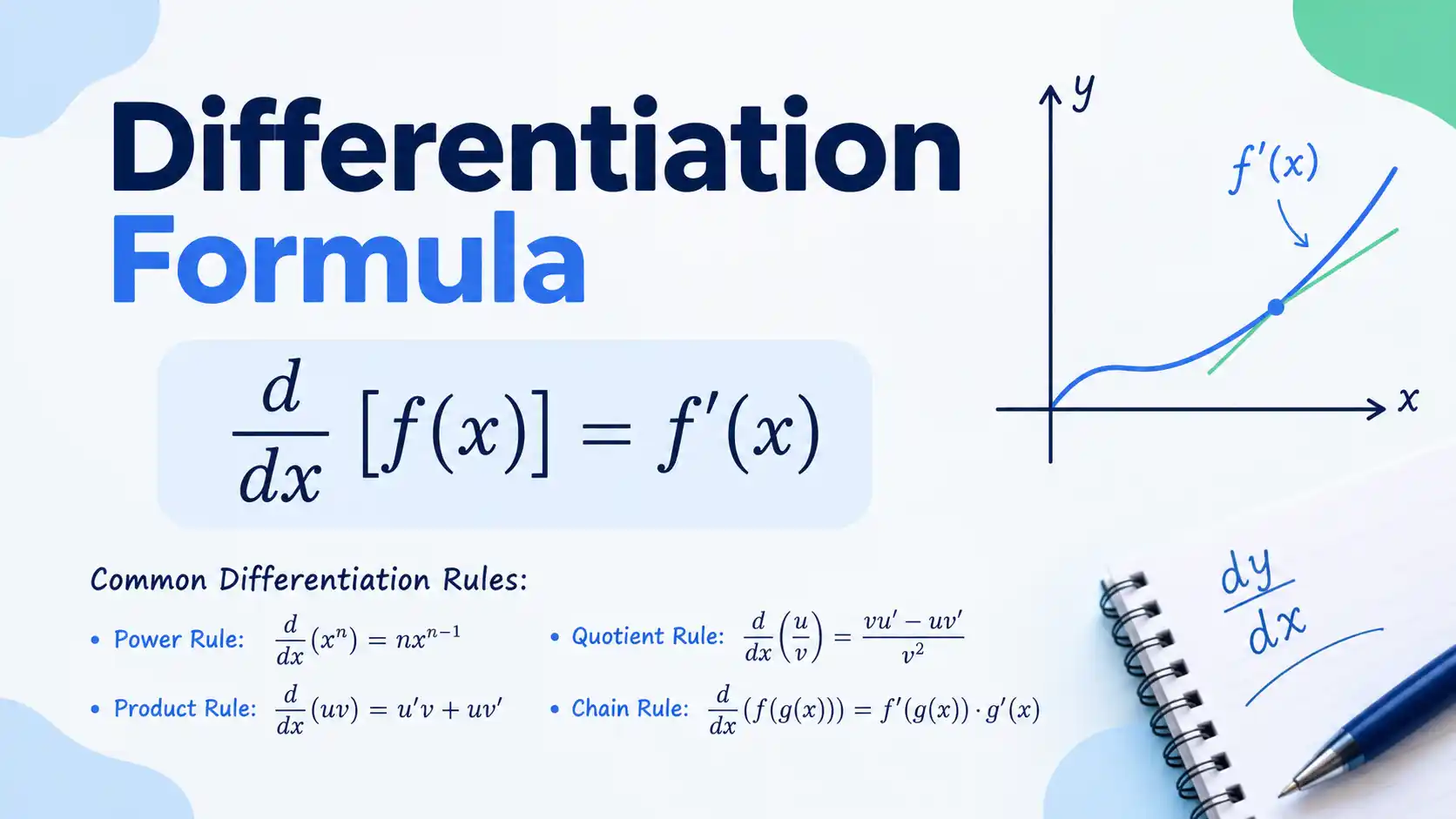
Differentiation Formula: Complete Derivative Formulas, Rules, Examples, and Shortcuts
Differentiation is one of the most important parts of calculus. It helps us find how quickly one quantity changes when another quantity changes. Students first meet basic differentiation through functions and limits and later use it in topics such as continuity and differentiability, applications of derivatives, maxima and minima, integration, physics, and engineering.
The good news is that differentiation does not require memorising hundreds of unrelated formulas. Most questions can be solved by understanding a small group of standard derivatives and knowing when to apply the power rule, sum rule, product rule, quotient rule, and chain rule.
This guide brings the important differentiation formulas together in one place. It starts with the basic idea of a derivative and then moves towards trigonometric, exponential, logarithmic, and inverse trigonometric derivatives. Worked examples are included so that students can see how the formulas are actually used.
The basic definition of a derivative is based on a limit:
f′(x)=limh→0f(x+h)−f(x)hf'(x)=\lim_{h\to0}\frac{f(x+h)-f(x)}{h}
This is also called the first principle of differentiation. NCERT describes the derivative in this form and introduces f′(x), f'(x), ddx\frac{d}{dx}, and dydx\frac{dy}{dx} as different notations for derivatives.
What Is Differentiation?
Differentiation is the process of finding the derivative of a function.
In simple terms, a derivative tells us about the rate at which a quantity is changing.
For example, suppose the distance travelled by a car is represented by s(t)s(t), where tt is time. The derivative
dsdt\frac{ds}{dt}
represents the instantaneous rate of change of distance with respect to time, which is velocity.
Similarly, if
y=f(x), y=f(x),
Then its derivative can be written as
dydx=f′(x)\frac{dy}{dx}=f'(x)
You may also see the notation:
Dx[f(x)]D_x[f(x)]
All of these describe differentiation with respect to xx.
Basic Differentiation Formulas
These are the formulas students should understand first.
| Function | Derivative |
| cc | 00 |
| xx | 11 |
| xnx^n | nxn−1nx^{n-1} |
| cf(x)cf(x) | cf′(x)cf'(x) |
| f(x)+g(x)f(x)+g(x) | f′(x)+g′(x)f'(x)+g'(x) |
| f(x)−g(x)f(x)-g(x) | f′(x)−g′(x)f'(x)-g'(x) |
Here, cc represents a constant.
The power rule
ddx(xn)=nxn−1\frac{d}{dx}(x^n)=nx^{n-1}
is one of the most frequently used differentiation formulas. NCERT introduces this rule after developing the derivative from first principles.
Example 1: Differentiate x^5x^5.
Using the power rule:
ddx(x5)=5×4\frac{d}{dx}(x^5)=5x^4
So,
5×4\boxed{5x^4}
Example 2: Differentiate 7x37x^3.
The constant 7 stays outside:
ddx(7×3)=7(3×2)\frac{d}{dx}(7x^3)=7(3x^2)
Therefore,
21×2\boxed{21x^2}
Example 3: Differentiate a constant
If
y=25, y=25,
then
dydx=0\frac{dy}{dx}=0
A constant does not change as xx changes, so its derivative is zero.
Differentiation Formula for Polynomials
For a polynomial, differentiate each term separately.
For example:
y=5x^4−3x^2+7x−9y=5x^4-3x^2+7x-9
Differentiate term by term:
dy/dx = 20x^3 – 6x + 7\frac{dy}{dx} = 20x^3 – 6x + 7
The constant −99 disappears because its derivative is zero.
Another example
If
f(x)=8x^5+4x^3−9x^2+6, f(x)=8x^5+4x^3-9x^2+6,
then
f′(x)=40x^4+12x^2−18xf'(x)=40x^4+12x^2-18x
This term-by-term approach is usually faster and less error-prone than trying to manipulate the entire expression at once.
Differentiation Rules
When a function becomes more complicated, standard rules tell us how to break it into manageable pieces.
1. Sum Rule
If
y=u+v, y=u+v,
then
dydx=dudx+dvdx\frac{dy}{dx}=\frac{du}{dx}+\frac{dv}{dx}
In short:
(u+v)’=u’+v'(u+v)’=u’+v’
The same idea applies to any number of terms. The sum rule is part of the standard algebra of derivatives described in NCERT.
Example
y=x^4+3x^2+5xy=x^4+3x^2+5x
Therefore,
y′=4x³+6x+5y′=4x³+6x+5
2. Difference Rule
For
y=u−v,y=u-v,
The derivative is
(u−v)′=u′−v′(u−v)’=u′−v′’
Example
y=x^5−4x^3y=x^5-4x^3
Then:
y′=5x^4−12x^2y’=5x^4-12x^2
3. Constant Multiple Rule
If cc is a constant,
ddx[cf(x)]=cddx[f(x)]\frac{d}{dx}[cf(x)]=c\frac{d}{dx}[f(x)]
For example:
y=12x^4y=12x^4
gives
y′=12(4x^3)=48x^3y′=12(4x^3)=48x^3
This rule is particularly useful when differentiating long polynomial expressions.
Product Rule
The product rule is used when two functions are multiplied together.
If
y=uv, y=uv,
then:
(uv)′=u′v+uv′\boxed{(uv)’=u’v+uv’}
A common mistake is to assume that the derivative of a product is simply u′v′u’v’. That is not correct.
The product rule is also known as the Leibniz rule. NCERT gives the same relationship in its algebra of derivatives.
Example
Differentiate:
y=x2sinxy=x^2\sin x
Take:
u=x², v=sinxu=x^2, \qquad v=\sin x
Then:
u′=2xu’=2x
and
v′=cosxv’=\cos x
Using the product rule:
y′=u′v+uv′y’=u’v+uv’
So:
y′= 2xsinx+x2cosx\boxed{y’=2x\sin x+x^2\cos x}
Easy way to remember the product rule
Think:
First derivative × second + first × second derivative
That helps prevent the common mistake of differentiating only one factor.
Quotient Rule
The quotient rule is used when one function is divided by another.
If
y=uv, y=\frac{u}{v},
then:
(uv)′=u′v−uv′v2\boxed{ \left(\frac{u}{v}\right)’ = \frac{u’v-uv’}{v^2} }
The denominator must be non-zero where the rule is being applied. This is the standard quotient rule given in NCERT’s treatment of derivatives.
Example
Differentiate:
y=x+1x−2y=\frac{x+1}{x-2}
Let:
u=x+1, v=x−2u=x+1, v=x-2
Therefore:
u′=1, v′=1, u’=1, v’=1
Now apply the quotient rule:
y′=1(x−2)−(x+1)(1)(x−2)2y’= \frac{1(x-2)-(x+1)(1)} {(x-2)^2}
Simplifying:
y′=x−2−x−1(x−2)2y’= \frac{x-2-x-1}{(x-2)^2} y′=−3(x−2)2\boxed{y’=-\frac{3}{(x-2)^2}}
with x≠2x\neq2.
Chain Rule
The chain rule is used when one function is inside another function.
For example:
y=(3x+2)5y=(3x+2)^5
Here, the expression 3x+23x+2 is inside the fifth power.
If
y=f(g(x)), y=f(g(x)),
then:
dydx=f′(g(x))g′(x)\boxed{ \frac{dy}{dx} = f'(g(x))g'(x) }
A useful student-friendly version is
Differentiate the outside function first, then multiply by the derivative of the inside function.
Example
Differentiate:
y=(3x+2)5y=(3x+2)^5
Differentiate the outside power:
5(3x+2)45(3x+2)^4
Then differentiate the inside:
ddx(3x+2)=3\frac{d}{dx}(3x+2)=3
Therefore:
dydx=15(3x+2)4\boxed{ \frac{dy}{dx}=15(3x+2)^4 }
Trigonometric Differentiation Formulas
Students should learn the basic trigonometric derivatives carefully because they appear repeatedly in calculus.
| Function | Derivative |
| sinx\sin x | cosx\cos x |
| cosx\cos x | −sinx-\sin x |
| tanx\tan x | sec2x\sec^2x |
| cotx\cot x | −cosec2x-\cosec^2x |
| secx\sec x | secxtanx\sec x\tan x |
| cosecx\cosec x | −cosecxcotx-\cosec x\cot x |
The basic derivatives of sinx\sin x, cosx\cos x, and tanx\tan x are included in NCERT’s standard derivative results.
Example
If
y=4sinx−3cosx,y=4\sin x-3\cos x,
then:
y′=4cosx+3sinxy’=4\cos x+3\sin x
Notice the negative sign in the derivative of cosx\cos x. Because the original term is already −3cosx-3\cos x, the two negative signs produce a positive term.
Exponential Differentiation Formulas
Some important exponential derivatives are
ddx(ex)=ex\frac{d}{dx}(e^x)=e^x
and
ddx(ax)=axlna\frac{d}{dx}(a^x)=a^x\ln a
where a>0a>0 and a≠1a\neq1.
Example
If
y=e³x, y=e^{3x},
The chain rule is required.
The derivative of eue^u is eue^u, and the derivative of 3x3x is 3.
Therefore:
dydx=3e3x\boxed{\frac{dy}{dx}=3e^{3x}}
Logarithmic Differentiation Formulas
For the natural logarithm:
ddx(lnx)=1x\boxed{ \frac{d}{dx}(\ln x)=\frac{1}{x} }
For a logarithm with base aa:
ddx(logax)=1xlna\boxed{ \frac{d}{dx}(\log_a x) = \frac{1}{x\ln a} }
where a>0a>0 and a≠1a\neq1.
Example
If
y=ln(5x),y=\ln(5x), y=\ln(5x), y=\ln(5x),
Use the chain rule:
y′=15x×5y’=\frac{1}{5x}\times5
Therefore:
y′=1x\boxed{y’=\frac1x}
Differentiation Formulas for Inverse Trigonometric Functions
These formulas become particularly important in higher-level calculus.
| Function | Derivative |
| sin−1x\sin^{-1}x | 11−x2\frac{1}{\sqrt{1-x^2}} |
| cos−1x\cos^{-1}x | −11−x2-\frac{1}{\sqrt{1-x^2}} |
| tan−1x\tan^{-1}x | 11+x2\frac{1}{1+x^2} |
| cot−1x\cot^{-1}x | −11+x2-\frac{1}{1+x^2} |
| sec−1x\sec^{-1}x | (\frac{1}{ |
| cosec−1x\cosec^{-1}x | (-\frac{1}{ |
For school-level work, always check the convention being used by your textbook or examination board, particularly for inverse cotangent and inverse secant/cosecant functions.
Differentiation Formula of a Function of a Function
Suppose:
y=f(u)y=f(u)
and
u=g(x).u=g(x).
Then:
dydx=dydu⋅dudx\frac{dy}{dx} = \frac{dy}{du}\cdot\frac{du}{dx}
This is another way of writing the chain rule.
Example
Find the derivative of:
y=sin(x2)y=\sin(x^2)
The outside function is sine, and the inside function is x²x².
Therefore:
dydx=cos(x2)⋅2x\frac{dy}{dx} = \cos(x^2)\cdot2x
So:
dydx=2xcos(x2)\boxed{\frac{dy}{dx}=2x\cos(x^2)}
Differentiation Formula for Square Root
A square root can be written as a fractional power:
x=x1/2\sqrt{x}=x^{1/2}
Using the power rule:
ddx(x1/2)=12x−1/2\frac{d}{dx}(x^{1/2}) = \frac12x^{-1/2}
Therefore:
ddx(x)=12x\boxed{ \frac{d}{dx}(\sqrt{x}) = \frac{1}{2\sqrt{x}} }
This conversion from roots to powers is a useful shortcut.
For example:
y=x^3y=\sqrt{x^3}
can be rewritten as
y=x³/2y=x^{3/2}
Hence:
y′=32×1/2y’=\frac32x^{1/2}
or:
y′=32x\boxed{y’=\frac32\sqrt{x}}
Differentiation Formula for 1/x1/x
Write:
1x=x−1\frac1x=x^{-1}
Now apply the power rule:
ddx(x−1)=−1x−2\frac{d}{dx}(x^{-1}) = -1x^{-2}
Therefore:
ddx(1x)=−1×2\boxed{ \frac{d}{dx}\left(\frac1x\right) = -\frac1{x^2} }
This is often easier than memorising it separately.
Differentiation Formula Table for Quick Revision
Here is a compact revision table students can save for practice.
| Function | Differentiation Formula |
| cc | 00 |
| xx | 11 |
| xnx^n | nxn−1nx^{n-1} |
| x\sqrt{x} | 12x\frac{1}{2\sqrt{x}} |
| 1/x1/x | −1/x2-1/x^2 |
| exe^x | exe^x |
| axa^x | axlnaa^x\ln a |
| lnx\ln x | 1/x1/x |
| sinx\sin x | cosx\cos x |
| cosx\cos x | −sinx-\sin x |
| tanx\tan x | sec2x\sec^2x |
| cotx\cot x | −cosec2x-\cosec^2x |
| secx\sec x | secxtanx\sec x\tan x |
| cosecx\cosec x | −cosecxcotx-\cosec x\cot x |
| sin−1x\sin^{-1}x | 1/1−x21/\sqrt{1-x^2} |
| cos−1x\cos^{-1}x | −1/1−x2-1/\sqrt{1-x^2} |
| tan−1x\tan^{-1}x | 1/(1+x²)1/(1+x²) |
How to Choose the Correct Differentiation Formula
One of the biggest problems for beginners is not knowing which rule to use.
A simple check can help.
If you see a power
Use the power rule.
Example:
x7x^7
If you see terms being added or subtracted
Differentiate each term separately.
Example:
x³+5x²−7xx³+5x²-7x
If two functions are multiplied
Use the product rule.
Example:
x2sinxx^2\sin x
If one function is divided by another
Use the quotient rule.
Example:
x2+1x−3\frac{x^2+1}{x-3}
If one function is inside another
Use the chain rule.
Example:
sin(x2)\sin(x^2)
If the expression contains several of these
Break it into smaller parts and apply the rules one at a time.
This approach is much safer than trying to remember one giant formula.
Solved Differentiation Examples
Example 1
Find the derivative of:
y=6x^4−2x^3+9x−10y=6x^4-2x^3+9x-10
Differentiate each term:
y′=24x³−6x²+9y′=24x³-6x²+9
Therefore:
24×3−6×2+9\boxed{24x^3-6x^2+9}
Example 2
Differentiate:
y=(x2+1)(x3−2)y=(x^2+1)(x^3-2)
Use the product rule.
Let:
u=x²+1u=x²+1
and
v=x³−2v=x³−2
Then:
u′=2x, v′=3x²u′=2x, v′=3x²
Therefore:
y′=2x(x³−2)+(x²+1)(3x²)y’=2x(x³-2)+(x²+1)(3x²)
Expand:
y′=2x^4−4x+3x^4+3x^2y’=2x^4-4x+3x^4+3x^2
Hence:
y′=5×4+3×2−4x\boxed{y’=5x^4+3x^2-4x}
Example 3
Differentiate:
y=x²+3x+1y=\frac{x^2+3}{x+1}
Using the quotient rule:
y′=(2x)(x+1)−(x²+3)(1)(x+1)²y’= \frac{(2x)(x+1)-(x^2+3) (1)} {(x+1)^2}
Simplifying:
y′=2×2+2x−x2−3(x+1)2y’= \frac{2x^2+2x-x^2-3}{(x+1)^2}
Therefore:
y′=x2+2x−3(x+1)2\boxed{ y’=\frac{x^2+2x-3}{(x+1)^2} }
Example 4
Differentiate:
y=(2x−5)4y=(2x-5)^4
Use the chain rule:
y′=4(2x−5)³(2)y’=4(2x-5)^3(2)
So:
y′=8(2x−5)3\boxed{y’=8(2x-5)^3}
Differentiation by First Principle
Although standard rules make differentiation much faster, students should understand the first principle because it explains where the derivative comes from.
The derivative of f(x)f(x) is:
f′(x)=limh→0f(x+h)−f(x)hf'(x)= \lim_{h\to0} \frac{f(x+h)-f(x)}{h}
Consider:
f(x)=x^2f(x)=x^2
Then:
f(x+h)=(x+h)^2f(x+h)=(x+h)^2
So:
f′(x)=limh→0(x+h)2−x2hf'(x) = \lim_{h\to0} \frac{(x+h)^2-x^2}{h}
Expand:
=limh→0x2+2xh+h2−x2h= \lim_{h\to0} \frac{x^2+2xh+h^2-x^2}{h} =limh→02xh+h2h= \lim_{h\to0} \frac{2xh+h^2}{h} =limh→0(2x+h)= \lim_{h\to0}(2x+h)
Therefore:
f′(x)=2x\boxed{f'(x)=2x}
This is the basic idea behind the derivative definition used in calculus.
Common Mistakes Students Make in Differentiation
1. Forgetting to reduce the power
For:
x5x^5
The answer is
5x45x^4
not 5x55x^5.
2. Differentiating a constant incorrectly
The derivative of 8 is 0, not 1.
3. Using u′v′u’v’ for a product
This is incorrect:
(uv)’=u’v’ (uv)’=u’v’
The correct product rule is
(uv)’=u’v+uv’ (uv)’=u’v+uv’
4. Forgetting the derivative of the inner function
For:
(4x+1)3(4x+1)^3
The answer is not simply
3(4x+1)23(4x+1)^2
You must also multiply by 4:
12(4x+1)212(4x+1)^2
5. Losing the negative sign
Remember:
ddx(cosx)=−sinx\frac{d}{dx}(\cos x)=-\sin x
and
ddx(cotx)=−cosec2x\frac{d}{dx}(\cot x)=-\cosec^2x
How to Learn Differentiation Formulas Easily
Trying to memorize the entire formula sheet in one sitting usually makes differentiation harder.
Instead, learn it in groups.
- First: constants and powers.
- Second: sum, difference, and constant multiple rules.
- Third: product and quotient rules.
- Fourth: trigonometric derivatives.
- Fifth: exponential and logarithmic derivatives.
- Finally: chain rule and inverse trigonometric functions.
After learning each group, solve five or ten questions immediately. This helps you recognize the structure of a question instead of simply trying to recall a formula.
A useful revision habit is to write the formula from memory and then check it against your textbook or notes. This is especially helpful for the signs in trigonometric and inverse trigonometric derivatives.
Why Differentiation Is Important
Differentiation is not just a chapter where students memorize formulas for an examination. It becomes a foundation for several later topics.
It is used to study:
- Rate of change
- Slope of a curve
- Velocity and acceleration
- Increasing and decreasing functions
- Maxima and minima
- Tangents and normals
- Optimization problems
- Motion problems
- Graph behavior
- Higher calculus
- Physics and engineering applications
The derivative can also be interpreted geometrically as the slope of the tangent to a curve at a point. NCERT’s treatment connects the limiting difference quotient with the slope of the tangent.
Differentiation Formula FAQs
What is the basic formula of differentiation?
The basic derivative definition is
f′(x)=limh→0f(x+h)−f(x)hf'(x)=\lim_{h\to0}\frac{f(x+h)-f(x)}{h}
For routine calculations, the power rule
ddx(xn)=nxn−1\frac{d}{dx}(x^n)=nx^{n-1}
is one of the most commonly used formulas.
What is the power rule in differentiation?
The power rule states that when differentiating xnx^n, multiply by the exponent and reduce the exponent by one:
ddx(xn)=nxn−1\frac{d}{dx}(x^n)=nx^{n-1}
What is the product rule?
For two differentiable functions uu and vv:
(uv)’=u’v+uv’ (uv)’=u’v+uv’
It is used when two functions are multiplied.
What is the quotient rule?
For v≠0v\neq0:
(uv)′=u′v−uv′v2\left(\frac uv\right)’= \frac{u’v-uv’}{v^2}
It is used when one differentiable function is divided by another.
What is the chain rule?
The chain rule is used for composite functions. If y=f(g(x)), then:
dydx=f′(g(x))g′(x)\frac{dy}{dx}=f'(g(x))g'(x)
In practical terms, differentiate the outer function and multiply by the derivative of the inner function.
What is the derivative of a constant?
The derivative of any constant is zero:
ddx(c)=0\frac{d}{dx}(c)=0
What is the derivative of xx?
ddx(x)=1\frac{d}{dx}(x)=1
What is the derivative of sinx\sin x?
ddx(sinx)=cosx\frac{d}{dx}(\sin x)=\cos x
What is the derivative of cosx\cos x?
ddx(cosx)=−sinx\frac{d}{dx}(\cos x)=-\sin x
Is differentiation difficult for beginners?
The first few questions can seem difficult because several rules look similar. Once you learn to identify whether a function is a power, product, quotient, or composite function, the process becomes much more straightforward. Regular practice is more useful than trying to memorize every formula at once.
Final Differentiation Formula Revision
For quick revision, remember these core formulas first:
ddx(c)=0\frac{d}{dx}(c)=0 ddx(xn)=nxn−1\frac{d}{dx}(x^n)=nx^{n-1} (uv)′=u′v+uv′(uv)’=u’v+uv’ (uv)′=u′v−uv′v2\left(\frac uv\right) ‘= \frac{u’v-uv’}{v^2} ddx[sinx]=cosx\frac{d}{dx}[\sin x]=\cos x ddx[cosx]=−sinx\frac{d}{dx}[\cos x]=-\sin x ddx[tanx]=sec2x\frac{d}{dx}[\tan x]=\sec^2x ddx[ex]=ex\frac{d}{dx}[e^x]=e^x ddx[lnx]=1x\frac{d}{dx}[\ln x]=\frac1x
and for a composite function:
ddxf(g(x))=f′(g(x))g′(x)\frac{d}{dx}f(g(x))=f'(g(x))g'(x)
Once these become familiar, many apparently complicated differentiation questions become a matter of recognizing the pattern and applying the appropriate rule.
Direct and Indirect Speech
Direct and indirect speech are important parts of English grammar that help us report what someone has said. In direct speech, we repeat the speaker’s exact words using quotation marks. For example, Ravi said, “I am busy.” In indirect speech, we report the same message without using the speaker’s exact words: Ravi said that he was busy. When changing direct speech into indirect speech, students may need to change the tense, pronouns, time expressions, and punctuation. Learning these basic rules makes it easier to write sentences correctly and understand reported conversations. This topic is useful for school exams, writing, and everyday English communication.