
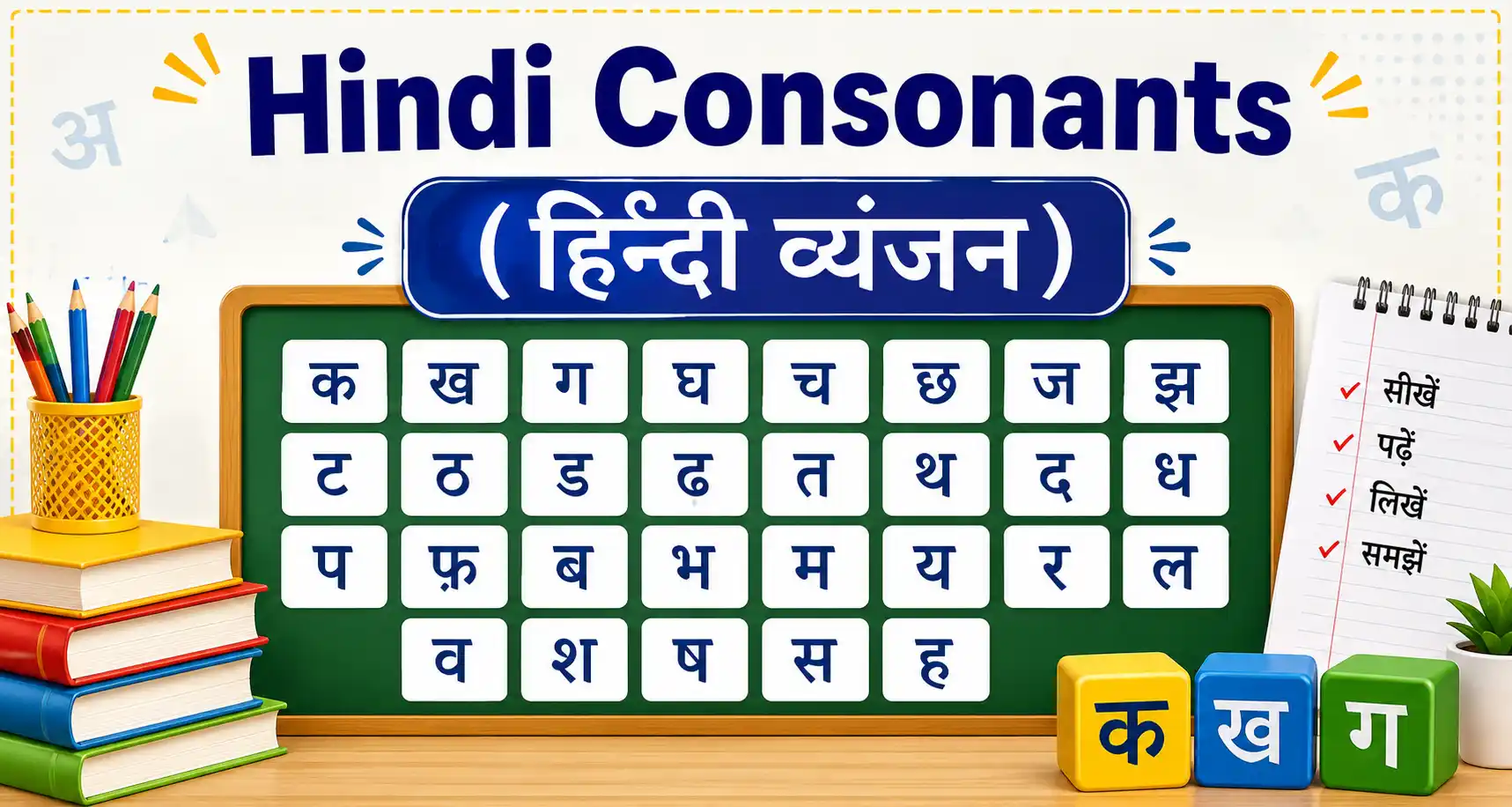
Hindi Consonants (व्यंजन): Complete Guide with List, Pronunciation, Examples and Worksheets
Learning Hindi consonants (व्यंजन) is one of the first and most important steps in understanding the Hindi language. Consonants are the building blocks of words, helping us form meaningful sounds when they are combined with vowels (स्वर). Whether you are a school student, a parent teaching children, or someone learning Hindi for the first time, understanding consonants makes reading, writing, and speaking much easier.
The Hindi alphabet consists of 33 primary consonants along with commonly used combined and borrowed consonants in modern Hindi. Each consonant has its own pronunciation and is grouped according to the place where the sound is produced in the mouth. This scientific arrangement makes the Hindi alphabet unique and easy to learn once you understand the basics.
In this guide, you’ll learn what Hindi consonants are, how they are classified, their pronunciation, easy examples for each letter, and practical tips to remember them quickly.
Table of Contents
- What Are Hindi Consonants?
- Hindi Consonants List
- Classification of Hindi Consonants
- Pronunciation Guide
- Examples of Every Hindi Consonant
- Difference Between Vowels and Consonants
- Tips to Learn Hindi Consonants Faster
- Practice Worksheets
- Frequently Asked Questions
What Are Hindi Consonants?
Hindi consonants, known as व्यंजन (Vyanjan), are letters that cannot usually be pronounced independently. They require the support of a vowel sound to produce a complete syllable. For example, the consonant क is naturally pronounced as ‘क + अ = क’, while other vowel signs can change its pronunciation to कि, कु, के, को, and so on.
Unlike vowels, which can be spoken independently, consonants work together with vowels to create words. Almost every Hindi word contains one or more consonants.
For example:
- कमल
- किताब
- घर
- बच्चा
- विद्यालय
In each of these words, consonants combine with vowels to create meaningful sounds.
Hindi Consonants List (व्यंजन)
क, ख, ग, घ, ङ
च, छ, ज, झ, ञ
ट, ठ, ड, ढ, ण
त, थ, द, ध, न
प, फ, ब, भ, म
य, र, ल, व
श, ष, स, ह
Modern Hindi also frequently uses:
क्ष, त्र, ज्ञ
These combined consonants appear in many textbooks and everyday words.
Classification
One of the interesting features of the Hindi alphabet is that consonants are arranged according to where the sound is produced in the mouth.
| Group | Hindi Letters | Pronunciation Area |
| Guttural | क ख ग घ ङ | Throat |
| Palatal | च छ ज झ ञ | Palate |
| Cerebral | ट ठ ड ढ ण | Roof of the mouth |
| Dental | त थ द ध न | Teeth |
| Labial | प फ ब भ म | Lips |
After these groups come the semi-vowels (य, र, ल, व) and the sibilants (श, ष, स) followed by ह.
This arrangement helps learners understand pronunciation more easily than simply memorizing letters.
Pronunciation of Hindi Consonants
Correct pronunciation is important for reading and speaking Hindi confidently.
For example:
- क – as in कमल
- ख – as in खरगोश
- ग – as in गमला
- घ – as in घर
- च – as in चम्मच
- ज – as in जल
- ट – as in टोपी
- त – as in तरबूज
- प – as in पतंग
- म – as in मछली
Practicing these sounds aloud every day improves pronunciation and reading fluency.
Insects Name
Insects Name are the names of common insects that help students identify and learn about the tiny creatures found around us. From butterflies and bees to ants, dragonflies, and ladybugs, each insect has unique features and plays an important role in nature. Learning insects’ names improves vocabulary, science knowledge, and observation skills for children. This easy-to-understand list includes popular insects with their names and simple facts, making it perfect for school projects, homework, and general learning. Whether you are a student, parent, or teacher, this guide will help you recognize different insects quickly and understand their importance in our ecosystem.