
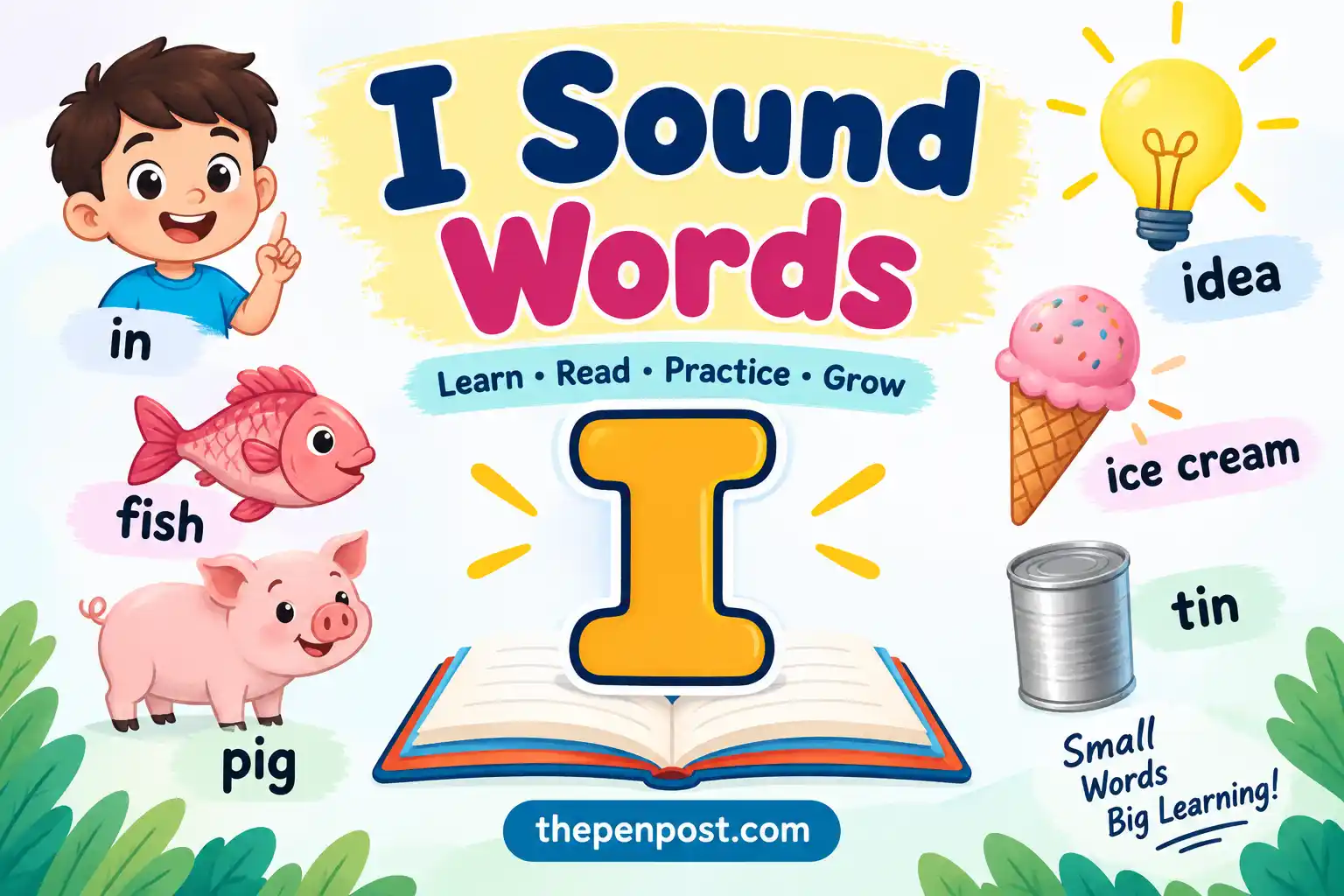
I Sound Words: Word Lists, Stories, and Activities
Learning the short “i” sound is an important step for children who are beginning to read. Once a child can hear the sound in a word and connect it with the letter i, many simple words become easier to read and spell.
Words such as “sit,” “pig,” “lip,” “fin,” and “win” all contain the short “i” sound.
This page includes short I-word lists, word families, simple sentences, a short reading passage, and activities that children can use for practice.
What Is the Short I Sound?
The short “I” sound is written as /ĭ/. It is the sound you hear in the middle of words such as
- sit
- big
- fish
- milk
- six
- hill
It is different from the long “I” sound, as in “bike,” “time,” and “five.”
When saying the short “i” sound, the mouth is relaxed, and the sound is short. It is similar to the sound in “ih.”
For a young learner, it can help to say a word slowly and listen to the middle sound:
p-i-g → /ĭ/
s-i-t → /ĭ/
f-i-sh → /ĭ/
The letter “i” does not always make the short “I” sound, so children should learn to notice the sound in the whole word.
Short I-CVC Words
CVC means consonant-vowel-consonant. These three-letter words are often among the first words children practice when learning short vowel sounds.
Here are some common short VC words:
| Word | Word | Word |
| bib | big | bin |
| bit | dig | dim |
| fine | fit | fix |
| hid | him | hip |
| hit | kid | lid |
| lip | mix | pig |
| pin | rip | sit |
| six | tin | tip |
| win | wig | zip |
Try reading each word slowly. Point to the middle letter “i” and say the short “i” sound before blending the sounds.
For example:
f – i – t → fit
p – i – n → pin
s – i – x → six
Short I Word Families
Word families are groups of words that share the same ending. They are useful because children can change the beginning sound while keeping the rest of the word.
-IB family
- bib
- fib
- rib
-id family
- bid
- did
- hid
- kid
- lid
-ig family
- big
- dig
- fig
- pig
- wig
I’m family.
- dim
- him
- rim
-in family
- bin
- fin
- pin
- sin
- tin
- win
-IP family
- dip
- hip
- lip
- rip
- sip
- tip
-it family
- bit
- fit
- hit
- kit
- sit
-ix family
- fix
- mix
- six
-ill family
- fill
- hill
- pill
- sill
-ink family
- link
- pink
- sink
- wink
-ish family
- dish
- fish
- wish
-first family
- first
- list
- mist
Not every word containing the letter “i” has a short “i” sound. For example, bird and girl contain an i, but the vowel sound is affected by the r. These are usually taught as r-controlled vowel words rather than short I words.
Short I Words With Blends and Digraphs
After children become comfortable with simple CVC words, they can move on to words with consonant blends and digraphs.
Examples include:
- chip
- chin
- fish
- flip
- grip
- skip
- slim
- slip
- spin
- stick
- swim
- twin
These words can be more challenging because there are more sounds to blend.
For example:
s – l – i – p → slip
s – p – i – n → spin
f – l – i – p → flip
Encourage the child to blend the sounds without guessing from the first letter.
Short Sentences for Beginning Readers
Short sentences give children a chance to use the words they have learned in context.
Simple CVC sentences
- The pig is big.
- Tim is six.
- Kim can sit.
- The lid is in the bin.
- The pig did a jig.
- Six fish swim.
- The kid has a big bib.
- Tim can fix it.
Sentences with blends
- The fish is in the dish.
- The twins spin.
- The frog can skip.
- The slim fish is quick.
- The pink pig is in the mud.
- The kids swim in the pond.
After reading a sentence, ask the child to point out the words containing the short “I” sound.
For example:
The pig is big.
The short “i” words are “pig” and “big.”
A Short Story With “I” Sound Words
Tim and the Fish
Tim went to the pond with his little sister.
He had a big tin box with him. Inside it was a small net.
“Can we get a fish?” his sister asked.
Tim did a quick spin and picked up the net.
A little fish swam near the bank.
Tim put the net in the water, but the fish slipped away.
His sister began to giggle.
“Missed it!”
Tim smiled and tried again.
This time, he caught the fish for a quick look. Then he put it back in the pond.
The fish swam away, and Tim and his sister went home.
Find the Short “I” Words
After reading the story, see if the child can find words such as the following:
Tim, little, sister, big, tin, fish, spin, slipped, missed, giggle
This is a simple way to move from reading individual words to noticing the same sound in a complete story.
Short I Word Practice
Reading the same word several times can help a child become more comfortable with the short I pattern. But practice does not have to mean repeating a word list over and over.
Try changing one word into another.
sit → sip → tip → tin → win
Ask the child to read each new word after changing only one letter.
You can also make a small word chain:
pig → pin → tin → tip → sip
The child has to look carefully at the changing letter instead of guessing the word.
Short Sorting Activity
Write short vowel words on small pieces of paper. Mix words containing a, e, i, o, and u.
For example:
- cat
- bed
- pig
- hot
- sun
- fish
- map
- sit
- cup
- red
Ask the child to place each word under the correct vowel.
For the short “i” group, words such as “pig,” “fish,” and “sit” belong together.
This activity is especially useful when a child sometimes confuses the short “I” with another vowel sound.
Draw What You Read
Reading and understanding should go together.
Give the child a sentence such as the following:
The pig is in the bin.
Ask them to read it and draw what is happening.
You can then ask:
- What animal did you read about?
- Where is the pig?
- Which words have the short “I” sound?
The activity takes only a few minutes, but it gives the child a reason to pay attention to the meaning of the sentence.
Say the Word and Find the Sound
Say a word aloud, such as fish.
Ask:
- What word did you hear?
- What vowel do you hear in the middle?
- Is it the short “i” sound?
- Can you name another word with the same sound?
The child might answer:
fish → i → short I → dish
This works well as a quick classroom activity or a short practice exercise at home.
Short I Practice List
Here is a larger list for reading practice:
bib, big, bin, bit, dig, dim, dip, fin, fit, fix, hid, him, hip, hit, kid, lid, lip, mix, pig, pin, rip, sip, sit, six, tin, tip, wig, win, wish, zip
Once these words become familiar, introduce slightly longer words such as the following:
little, picnic, finish, winter, kitten, sister, simple, ribbon, window, chicken
These longer words give children a chance to notice the short “I” sound in more natural reading.
A Note for Parents and Teachers
Children do not all learn vowel sounds at the same pace. If a child reads “pig” correctly one minute and then struggles with it later, that does not necessarily mean they have forgotten everything. They may simply need more practice connecting sounds to letters.
Keep the practice short and positive. A few minutes of word reading, followed by a sentence or a short game, can be more useful than a long session that leaves the child frustrated.
It is also worth listening carefully when a child says a word. If “sit” sounds more like “set,” have them compare the two sounds and try again rather than simply telling them the answer.
Quick Short Review
The short “i” sound is heard in words such as
Sit, pig, fish, six, lip, fin, and win.
Remember these three steps:
See the letter i → say the short i sound → blend the word.
With regular practice, children can move from simple CVC words to blends, longer words, sentences, and short stories.
The most important thing is to help children notice the sound and use it while they are actually reading—not just memorize a list of words.
XXVII Roman Numerals
XXVII Roman numerals represent the number 27. It is made up of X, X, V, I, and I. In Roman numerals, X means 10, V means 5, and I means 1. So, XXVII = 10 + 10 + 5 + 1 + 1 = 27. You may see XXVII in old books, clock designs, historical dates, chapter numbers, or numbered lists. Learning Roman numerals becomes easier when you remember the value of each symbol and add them in order. If you are studying Roman numerals for school, understanding XXVII is a simple way to practice forming numbers correctly.