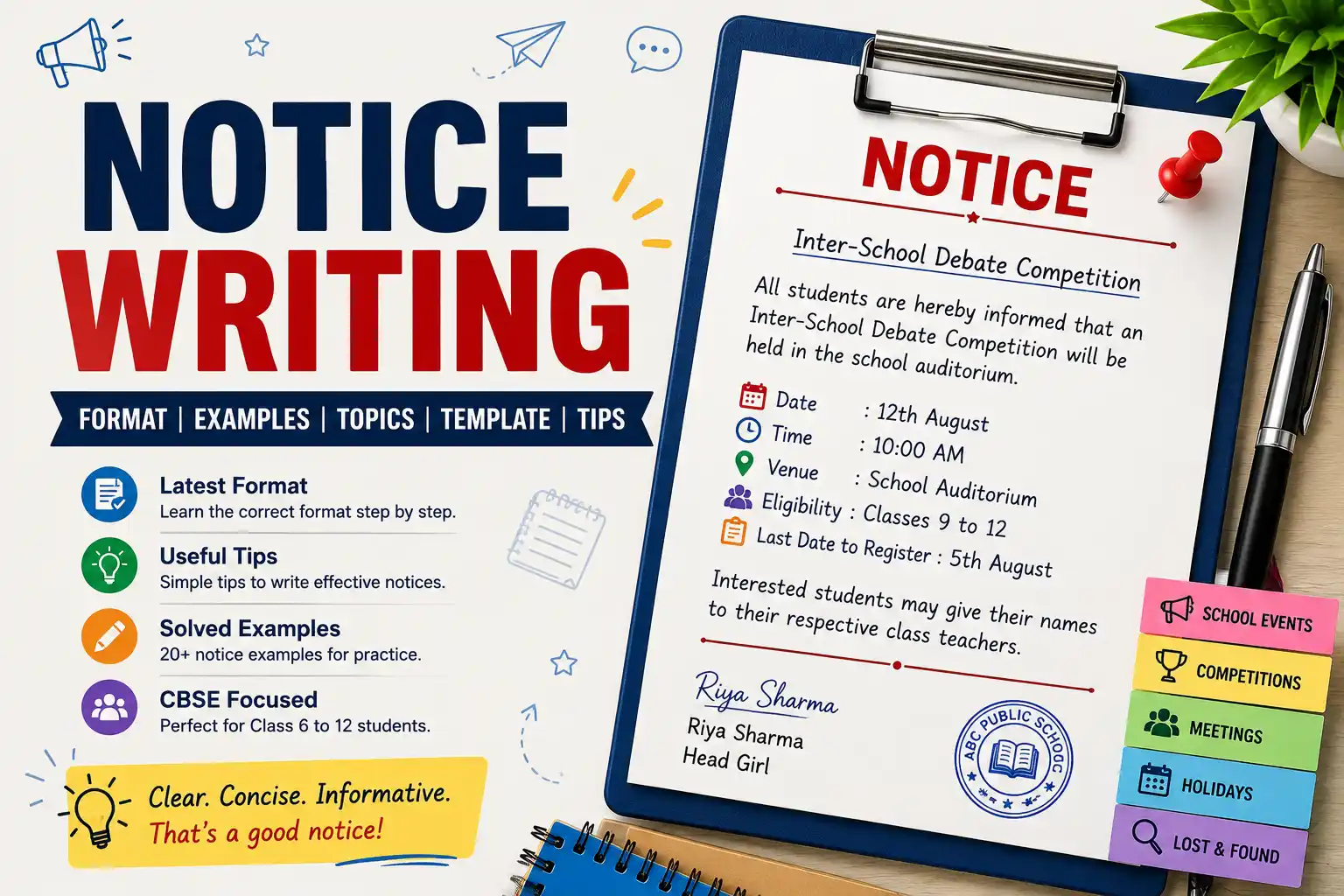
Notice writing is one of the most important writing skills taught in schools. It is a common question in CBSE, ICSE, and many state board examinations, especially for students in Classes 6 to 12. Whether the notice concerns a school event, competition, meeting, cultural program, lost-and-found item, or examination schedule, students are expected to present information in a clear, concise, and well-organized format.
A well-written notice communicates essential information without unnecessary details. It follows a fixed structure that includes the organization name, title, date, heading, body, and signature. Learning this format not only helps students score better marks in examinations but also develops practical communication skills that are useful in schools, colleges, workplaces, and public organizations.
You will learn its meaning, purpose, format, key features, writing tips, templates, solved examples, and sample notices for Class 10, Class 11, and Class 12. By the end of this article, you will be able to write any notice confidently according to the latest CBSE guidelines.
Table of Contents
- What is Notice Writing?
- Purpose and Importance of Notice Writing
- Key Features of Notice Writing
- Types of Notice Writing
- Format of Notice Writing
- Marking Scheme for Notice Writing
- Step-by-Step Process to Write a Notice
- Tips for Notice Writing
- Notice Writing Template
- Examples of Notice Writing
- Sample Notice Writing for Class 10
- Sample Notice Writing for Class 11
- Sample Notice Writing for Class 12
- Common Mistakes to Avoid
- Practice Questions
- Frequently Asked Questions
What is Notice Writing?
It is the process of preparing a short and formal written announcement to inform a specific group of people about an event, activity, meeting, competition, examination, holiday, or any other important information.
A notice is usually displayed on a notice board, school website, office portal, or public information board so that everyone concerned receives the message quickly. Unlike letters or emails, a notice focuses only on essential facts. It avoids lengthy explanations and presents information in a simple, organized format.
Definition
Notice writing is a formal method of communicating important information to a particular group of people through a brief and organized written announcement.
Purpose and Importance of Notice Writing
The main purpose of a notice is to provide important information to the intended audience in the shortest possible time. A notice ensures that everyone receives the same message without confusion or misunderstanding.
Notice writing plays an essential role in schools, colleges, offices, residential societies, clubs, and government organizations. It serves as an official means of communication for informing people about upcoming events, changes in schedules, meetings, competitions, lost items, or important announcements.
Students who understand notice writing gain valuable communication skills that extend beyond examinations. The ability to present information accurately and professionally is useful in higher education and future careers.
- Informing people about upcoming events.
- Announcing competitions, seminars, and workshops.
- Sharing examination schedules.
- Inviting participants for cultural programs.
- Reporting lost and found items.
- Announcing school holidays.
- Providing emergency information.
- Notifying students about meetings.
- Communicating changes in schedules.
- Making official public announcements.
Why is Notice Writing Important?
This is much more than an examination topic. It develops practical communication skills that students use throughout their academic and professional lives.
Helps Students Score Better Marks
Notice writing carries weightage in CBSE and other board examinations. A clear understanding of the correct format improves scoring potential.
Develops Professional Communication Skills
Students learn how to communicate formally using simple, precise, and organized language.
Saves Time
Since notices are brief and direct, readers can understand the message within seconds.
Avoids Miscommunication
A properly written notice includes all essential details, reducing confusion among readers.
Builds Writing Confidence
Regular practice helps students express important information confidently and accurately.
Key Features
Every effective notice shares certain characteristics. These features help readers understand the message quickly while maintaining professionalism.
1. Formal Language
A notice always uses polite, professional, and formal language. Slang, abbreviations, and conversational expressions should be avoided.
2. Concise Writing
A notice contains only essential information. It avoids unnecessary descriptions and lengthy explanations.
3. Clear Heading
The heading immediately tells readers what the notice is about.
Examples include:
- Science Exhibition
- Annual Sports Day
- Debate Competition
- Blood Donation Camp
- Lost Wallet
- Parent-Teacher Meeting
4. Accurate Information
Every notice should answer the reader’s basic questions:
- What is happening?
- Who is organizing it?
- Who should attend?
- When will it take place?
- Where will it be held?
- How can participants register?
5. Proper Structure
A notice follows a fixed format that includes:
- Name of the organization
- Title “NOTICE”
- Date
- Subject
- Body
- Signature
- Name
- Designation
6. Specific Audience
Every notice is written for a particular group rather than for everyone.
Examples include:
- Students
- Teachers
- Parents
- Club members
- Employees
- Residents
- Volunteers
Although the basic format remains the same, notices are written for different purposes depending on the situation.
School Notices
These notices inform students about school activities such as annual functions, competitions, educational tours, examination schedules, admissions, and holidays.
Event Notices
These notices announce seminars, workshops, sports events, exhibitions, cultural programmes, and celebrations.
Meeting Notices
Meeting notices provide information about the date, venue, agenda, and participants of official meetings.
Competition Notices
Schools frequently issue notices regarding debate competitions, essay writing contests, quiz competitions, drawing competitions, science fairs, and cultural events.
Lost and Found Notices
These notices help locate lost belongings or identify found items by providing a brief description and contact details.
Public Notices
Public notices are issued by government offices, housing societies, organizations, or institutions to inform the general public about important developments.
Examination Notices
These notices include examination timetables, admit card collection dates, practical examination schedules, result announcements, and revision classes.
Holiday Notices
Educational institutions and organizations use holiday notices to inform students or employees about scheduled vacations or unexpected closures.
How Many Calories Are in an Apple?
A medium-sized apple contains about 95 calories, making it a healthy and filling snack for people of all ages. Smaller apples usually have around 77 calories, while larger ones can provide about 116 calories. Apples are naturally low in fat, rich in dietary fiber, and packed with vitamin C and antioxidants that support overall health. The exact calorie count depends on the apple’s size and variety, but all apples are a nutritious choice. Eating an apple between meals can help reduce hunger, support weight management, and provide steady energy without adding too many calories to your daily diet.