
Rainbow Colours: 7 Colours of the Rainbow in Order, Names, Meaning and Facts
A rainbow is one of the most beautiful natural phenomena we can see in the sky. It usually appears when sunlight interacts with water droplets in the atmosphere, creating a colourful arc that can be seen after rain or near waterfalls, fountains, and sprinklers.
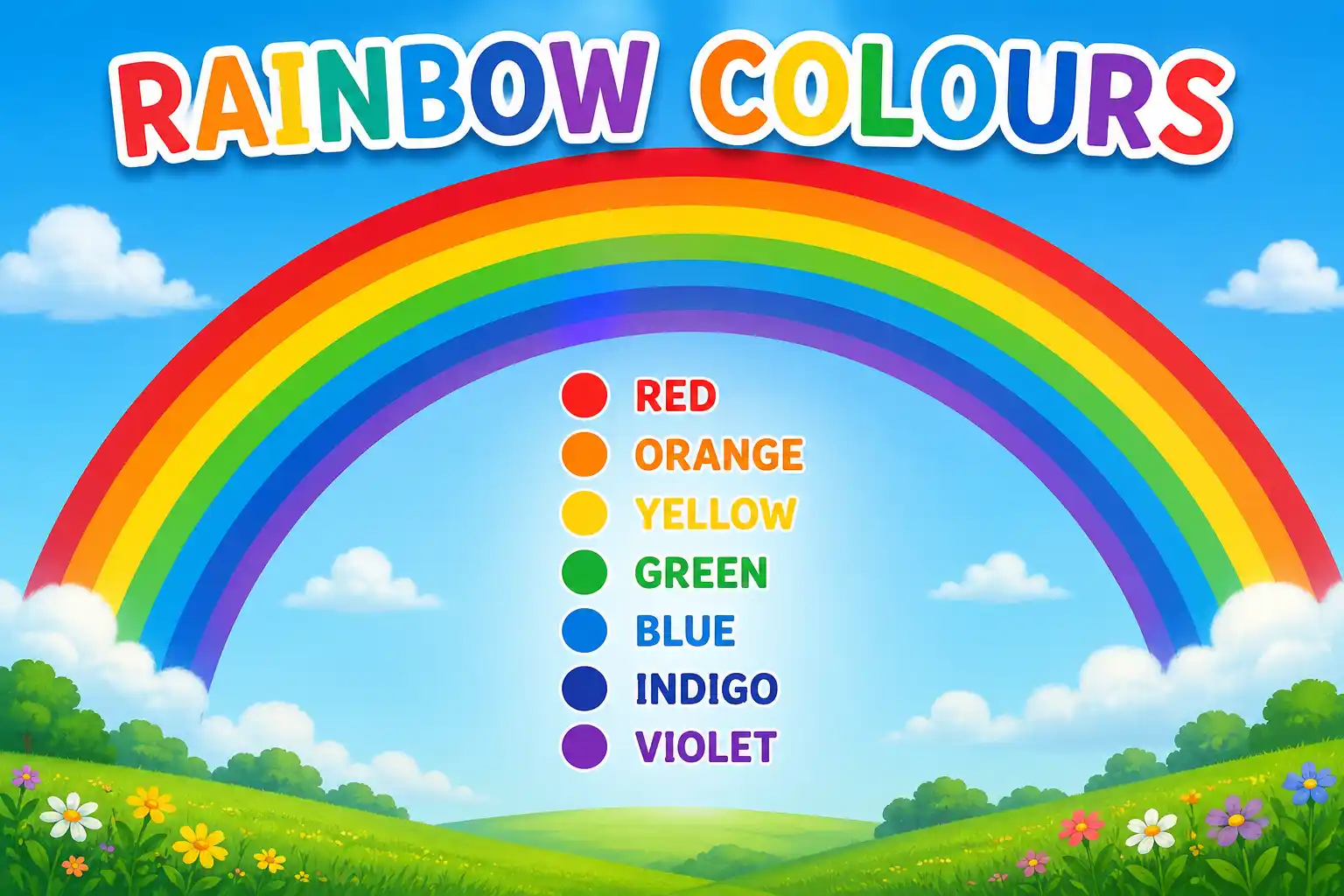
The seven commonly named rainbow colours are Red, Orange, Yellow, Green, Blue, Indigo and Violet. Their order can be remembered with the word VIBGYOR when reading from violet to red, or ROYGBIV when reading from red to violet.
Learning rainbow colours is useful for children because it connects basic colour recognition with science, nature, and the behavior of light. In this guide, you will learn the names of the rainbow colours, their order, how a rainbow forms, an easy way to remember them, interesting facts, and answers to common questions.
7 Rainbow Colours in Order
The seven colours traditionally used to describe a rainbow are
| Order | Rainbow Colour |
| 1 | Red |
| 2 | Orange |
| 3 | Yellow |
| 4 | Green |
| 5 | Blue |
| 6 | Indigo |
| 7 | Violet |
So, the rainbow colours from outer edge to inner edge are
Red → Orange → Yellow → Green → Blue → Indigo → Violet
The reverse sequence is:
Violet → Indigo → Blue → Green → Yellow → Orange → Red
This sequence is commonly remembered as VIBGYOR.
What Is VIBGYOR?
- V – Violet
- I – Indigo
- B – Blue
- G – Green
- Y – Yellow
- O – Orange
- R – Red
If you prefer to remember the colours from red to violet, ROYGBIV provides the same sequence in reverse:
- R – Red
- O – Orange
- Y – Yellow
- G – Green
- B – Blue
- I – Indigo
- V – Violet
Both methods are useful for students because they make the sequence easier to recall during school activities and exams.
What Are Rainbow Colours?
Sunlight may look white to our eyes, but it contains the range of visible colours.
As the separated light leaves the droplets, we can see the familiar spectrum of colours.
The main scientific processes involved are refraction, internal reflection, and dispersion.
It is important to understand that a rainbow does not actually contain seven sharply separated bands. The visible spectrum is continuous, so colours gradually blend into one another. The traditional seven-colour description is a useful way of naming and teaching the visible spectrum. Some scientific resources also point out that indigo is difficult to distinguish clearly from blue and violet.
Names of the 7 Colours of the Rainbow
1. Red
Red is the outermost colour of a primary rainbow. It has the longest wavelength among the traditionally listed rainbow colours.
Red is easy to notice because it generally forms the upper or outer edge of the main rainbow. In everyday life, we see red in objects such as apples, roses, traffic signals, and many flowers.
2. Orange
Orange comes immediately after red. It is a warm colour that sits between red and yellow in the visible spectrum.
3. Yellow
Yellow is the third commonly named rainbow colour. It is bright and easily associated with sunlight, flowers, and ripe fruits.
Yellow appears between orange and green in the rainbow sequence. It is also one of the colours that children usually identify quickly when learning basic colour names.
4. Green
Green is the fourth colour in the traditional sequence and therefore sits approximately in the middle of the seven-colour list.
In the rainbow, green appears between yellow and blue.
5. Blue
Blue is the fifth traditionally named rainbow colour. It lies between green and indigo.
Blue is commonly associated with the sky and water. It is also an important part of the visible spectrum and has a shorter wavelength than green, yellow, orange and red.
6. Indigo
Indigo is the sixth colour in the traditional seven-colour sequence.
It is generally described as a deep blue-violet shade and appears between blue and violet. However, indigo is not always visually distinguishable as a separate band because the colours in a rainbow form a continuous spectrum.
7. Violet
Violet forms the innermost edge of a primary rainbow.
It has the shortest wavelength among the traditionally listed seven colours.
Rainbow Colours Chart
Here is a simple chart that students can use for quick revision:
| Colour | Position | Simple Example |
| Red | 1 | Apple |
| Orange | 2 | Orange fruit |
| Yellow | 3 | Sunflower |
| Green | 4 | Grass |
| Blue | 5 | Sky |
| Indigo | 6 | Deep blue shade |
| Violet | 7 | Violet flower |
This table can also help younger children practice spelling and colour recognition.
Why Does a Rainbow Have Colours?
The colours of a rainbow are produced because sunlight is made up of different wavelengths of visible light.
When sunlight enters a raindrop, the light bends because it moves from air into water. The different wavelengths bend by different amounts. This process separates the colours. Some of the light is then reflected inside the droplet before leaving it.
When millions of water droplets interact with sunlight at suitable angles, the separated light reaches our eyes and appears as a rainbow.
The different wavelengths are responsible for the familiar colour sequence. Red has the longest wavelength among the traditionally listed rainbow colours, while violet has the shortest.
How Is a Rainbow Formed?
A rainbow needs two basic ingredients:
- A source of light, usually the Sun.
- Water droplets suspended in the air.
A simplified explanation is
Sunlight → enters a water droplet → bends and separates → reflects inside the droplet → leaves the droplet → reaches our eyes
For this reason, rainbows are commonly visible when the sun is shining while rain or fine water droplets are present.
You may also see a rainbow around a sprinkler or garden hose on a sunny day. A similar effect can be produced using a glass prism because a prism can also disperse white light into its component colours.
Why Is Red on the Outside of a Rainbow?
Red appears on the outer edge of a primary rainbow because its wavelength is longer than the wavelengths of the other traditionally listed rainbow colours.
Violet, which has a shorter wavelength, appears toward the inner edge.
Therefore, when looking at a primary rainbow, the usual order from outside to inside is:
Red → Orange → Yellow → Green → Blue → Indigo → Violet
This is one of the easiest science facts about rainbows for students to remember.
Why Is Violet on the Inside?
Violet has a shorter wavelength than the other traditionally listed colours. Because different wavelengths are refracted by different amounts as light passes through water droplets, violet appears toward the inside of the primary rainbow.
This is why red and violet occupy opposite edges of the main rainbow.
What Is a Double Rainbow?
Sometimes you may notice a second, fainter rainbow outside the main rainbow. This is called a double rainbow.
A double rainbow occurs when light undergoes additional internal reflection inside water droplets. The second rainbow appears above the primary rainbow and has its colour sequence reversed.
In a primary rainbow, red is generally on the outer edge and violet toward the inner edge. In a secondary rainbow, the order is reversed.
Double rainbows are less bright than primary rainbows because the additional reflection causes some light to be lost.
Are There Really Seven Colours in a Rainbow?
The answer depends on how we describe colour.
The traditional school-level description identifies seven colours:
Red, Orange, Yellow, Green, Blue, Indigo and Violet.
However, a rainbow is actually a continuous spectrum of visible light, meaning there are gradual transitions between colours rather than seven perfectly separated bands. Scientists may therefore describe the spectrum without treating each of the seven traditional names as a separate physical section.
The seven-colour model remains useful for education because it gives children a simple way to understand and remember the visible spectrum.
Rainbow Colours and Wavelength
Light can be described in terms of wavelength. The visible colours occupy different parts of the visible-light range.
In the traditional rainbow sequence, wavelength decreases as we move from red toward violet.
Red → Orange → Yellow → Green → Blue → Indigo → Violet
Therefore:
- Red has a relatively longer wavelength.
- Violet has a relatively shorter wavelength.
- The colours between them gradually change in wavelength.
This difference helps explain why the colours separate when sunlight passes through water droplets.
Easy Ways to Remember Rainbow Colours
Method 1: VIBGYOR
The most common Indian school mnemonic is the following:
VIBGYOR
- V – Violet
- I – Indigo
- B – Blue
- G – Green
- Y – Yellow
- O – Orange
- R – Red
Method 2: ROYGBIV
Another popular mnemonic is
ROYGBIV
- R – Red
- O – Orange
- Y – Yellow
- G – Green
- B – Blue
- I – Indigo
- V – Violet
ROYGBIV is particularly useful when remembering the colours from the outside of a primary rainbow toward the inside. Educational science resources commonly use this sequence.
Rainbow Colours in Hindi
For students learning colour names in both English and Hindi, the traditional seven rainbow colours can be listed as follows:
| English | Hindi |
| Red | लाल |
| Orange | नारंगी |
| Yellow | पीला |
| Green | हरा |
| Blue | नीला |
| Indigo | जामुनी |
| Violet | बैंगनी |
The exact Hindi naming of shades can vary by educational resource and context, particularly for indigo and violet.
Rainbow Colours for Kids
Teaching rainbow colours can be made fun through everyday examples.
Ask children to match:
- Red with an apple
- Orange with an orange
- Yellow with a sunflower
- Green with grass
- Blue with the sky
- Indigo with a dark blue shade
- Violet with a violet flower
Children can also draw a rainbow using seven curved lines and colour each band in the correct sequence.
A simple classroom activity is to ask students to write VIBGYOR and then expand each letter into the corresponding colour name. This combines spelling, memory and science learning.
How to Make a Rainbow at Home
You do not always need rain to see a rainbow.
On a sunny day, a fine spray of water from a garden hose or sprinkler can sometimes produce a small rainbow. Stand with the Sun behind you and allow the water droplets to pass through the sunlight in front of you.
The tiny droplets act somewhat like miniature prisms by refracting, reflecting, and dispersing light.
For children, this can be an enjoyable way to observe the science of light outside the classroom.
Interesting Facts About Rainbow Colours
- A rainbow is produced by the interaction of light and water droplets.
- Red is generally on the outer edge of a primary rainbow.
- Violet is generally on the inner edge.
- VIBGYOR is a common mnemonic for remembering the traditional seven colours.
- ROYGBIV gives the same colours in the opposite direction.
- Green is the fourth colour in the traditional seven-colour sequence.
- Red has a longer wavelength than violet.
- Violet has a shorter wavelength than red.
- A second rainbow can sometimes appear outside the primary rainbow.
- The colours of a rainbow form a continuous spectrum rather than seven perfectly separated bands.
What Is the Middle Colour of the Rainbow?
If the traditional seven colours are counted in order, green is the fourth colour:
Red → Orange → Yellow → Green → Blue → Indigo → Violet
Which Colour Has the longest wavelength?
Red has the longest wavelength among the traditionally listed rainbow colours.
Moving from red toward violet, the wavelength becomes shorter.
Which Colour Has the shortest wavelength?
Violet has the shortest wavelength among the traditionally listed seven rainbow colours.
This is why red and violet appear at opposite ends of the primary rainbow.
Can You See a Rainbow at Night?
A rainbow is normally associated with sunlight, but a similar phenomenon called a moonbow can occur when moonlight interacts with water droplets under suitable conditions.
Moonbows are much fainter than ordinary rainbows because moonlight is far weaker than direct sunlight.
Can a rainbow have more than seven colors?
Yes. From a scientific perspective, visible light forms a continuous spectrum. The seven-colour description is a traditional way of dividing that spectrum into named sections.
There are gradual changes between red and orange, orange and yellow, yellow and green, and so on. Therefore, a rainbow does not have only seven physically separate colours.
This distinction is useful when students move from basic colour lessons to more advanced topics in light and optics.
Rainbow Colours: Quick Revision
If you need a short answer for schoolwork, remember this:
The seven traditionally named colours of the rainbow are Red, Orange, Yellow, Green, Blue, Indigo and Violet. A rainbow forms when sunlight interacts with water droplets, causing the light to bend, separate, and reflect before reaching our eyes.
Frequently Asked Questions About Rainbow Colours
What are the 7 colours of the rainbow?
The seven traditionally named colours are Red, Orange, Yellow, Green, Blue, Indigo and Violet.
What does VIBGYOR stand for?
VIBGYOR stands for Violet, Indigo, Blue, Green, Yellow, Orange and Red.
What is the order of rainbow colours?
From the outer edge of a primary rainbow to the inner edge, the usual order is Red, Orange, Yellow, Green, Blue, Indigo and Violet.
Why does a rainbow have seven colours?
Seven is the traditional number used to name the major colour bands in a rainbow. Scientifically, the rainbow is a continuous spectrum, so there are gradual transitions between the colours rather than seven perfectly separated sections.
Which is the first colour of the rainbow?
When the rainbow is listed from the outer edge inward, red is the first colour.
Which is the last colour of the rainbow?
When listed from the outer edge inward, violet is the seventh and innermost traditionally named colour.
Which colour is in the middle of the rainbow?
Green is the fourth colour in the traditional seven-colour sequence, making it the middle colour when the seven colours are counted.
Why does red appear outside and violet inside?
Different colours of light have different wavelengths and are refracted by different amounts when passing through water droplets. This produces the characteristic order of colours in a primary rainbow.
Can I make a rainbow at home?
Yes. On a sunny day, spraying a fine mist of water into the air with the Sun behind you can sometimes produce a small rainbow.
Is indigo really a separate rainbow colour?
Indigo can be difficult to distinguish clearly from neighboring blue and violet shades.
Conclusion
Rainbow colours make a simple but fascinating introduction to the science of light. The seven colours traditionally taught are Red, Orange, Yellow, Green, Blue, Indigo and Violet, with ROYGBIV and VIBGYOR serving as easy memory aids.
A rainbow forms when sunlight interacts with water droplets, allowing the different wavelengths of visible light to separate and become visible to our eyes. Red generally appears on the outer edge of a primary rainbow, while violet appears on the inner edge.
For children and students, learning rainbow colours is more than memorizing seven names.
Exploring Colours Name: A Vibrant Spectrum
Color names enrich our world, offering a way to describe the vast spectrum of hues we encounter daily. From the fiery passion of “Crimson” to the calming tranquility of “Azure,” each name evokes distinct emotions and imagery. “Emerald” conjures lush, verdant forests, while “Amber” radiates warm, golden tones reminiscent of sunsets. Colors like “Indigo” and “Turquoise” blend blue and green shades, each with its unique character.




[…] Rainbow Colours […]