ICSE Full Form: Meaning, Eligibility, Subjects, and Benefits
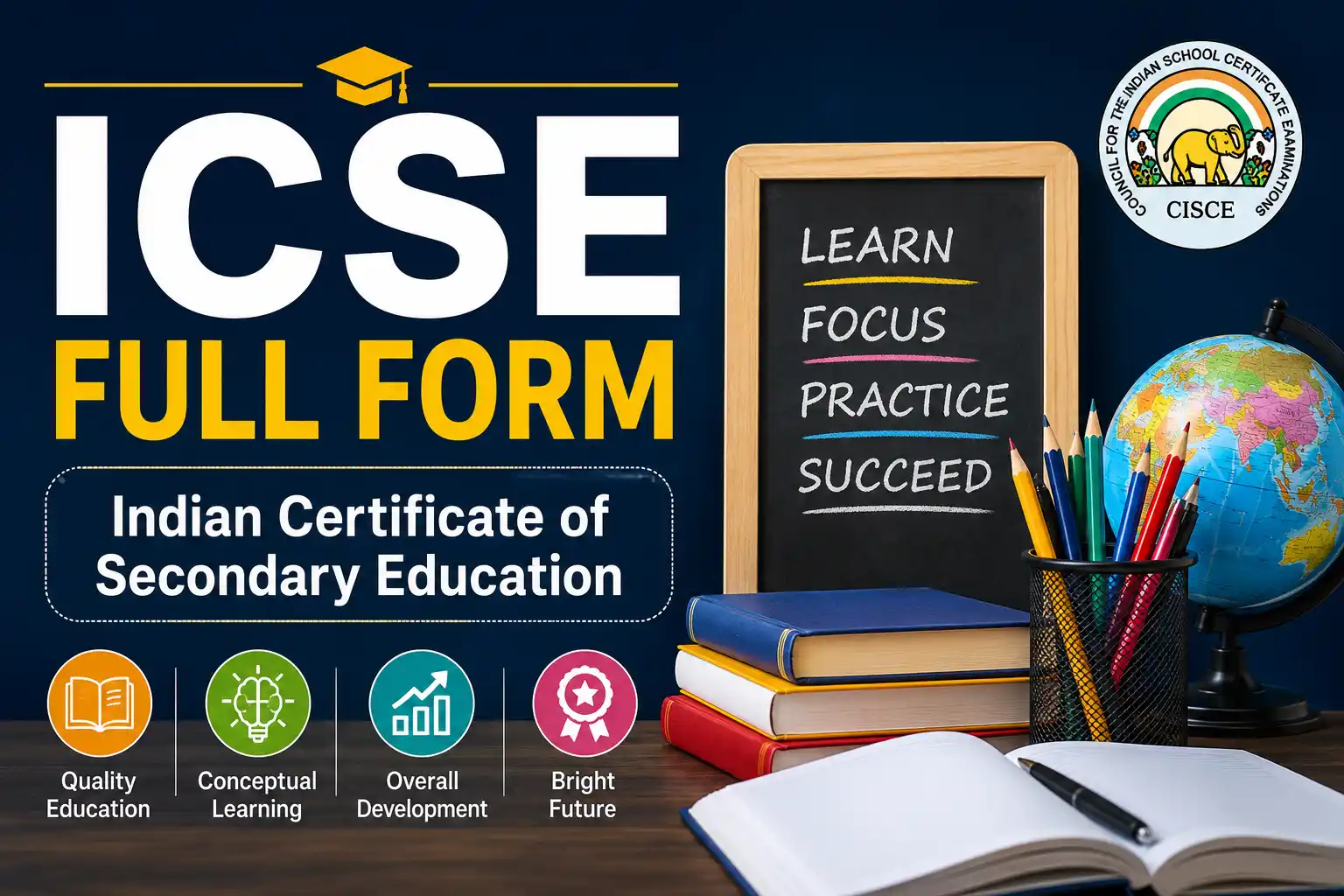
The ICSE full form is the Indian Certificate of Secondary Education. It is a nationally recognized examination conducted by the Council for the Indian School Certificate Examinations (CISCE) for students completing Class 10 in India.
The board encourages students to develop analytical thinking, creativity, and problem-solving abilities through a well-structured syllabus.
Many parents and students prefer ICSE because it offers an in-depth education that prepares learners for higher studies and competitive examinations.
What Is ICSE?
The Indian Certificate of Secondary Education (ICSE) is a Class 10 board examination conducted by the Council for the Indian School Certificate Examinations (CISCE). The curriculum is designed to provide students with a strong foundation in languages, mathematics, science, social studies, arts, and practical subjects.
Unlike many other boards, ICSE places equal importance on theoretical knowledge and practical application, helping students build critical thinking and communication skills.
ICSE Full Form at a Glance
| Particular | Details |
| Full Form | Indian Certificate of Secondary Education |
| Conducting Body | Council for the Indian School Certificate Examinations (CISCE) |
| Education Level | Secondary (Class 10) |
| Board Type | Private National Board |
| Medium of Instruction | English |
| Recognized By | Universities and educational institutions in India and abroad |
History of ICSE
The Council for the Indian School Certificate Examinations (CISCE) was established in 1958 to provide quality education through a comprehensive curriculum.
Over the years, the ICSE board has gained recognition for maintaining high academic standards and producing students with strong language proficiency and analytical skills.
Objectives of ICSE
The primary objectives of the ICSE curriculum are
- Provide quality education with conceptual understanding.
- Develop critical thinking and analytical skills.
- Encourage practical and project-based learning.
- Improve English communication and writing skills.
- Promote creativity, leadership, and overall personality development.
- Prepare students for higher education and global opportunities.
Subjects in ICSE
The ICSE curriculum covers a wide range of subjects.
Group I (Compulsory Subjects)
- English
- Second Language
- History, Civics, and Geography
Group II
Students choose subjects such as the following:
- Mathematics
- Science (Physics, Chemistry, Biology)
- Economics
- Commercial Studies
- Environmental Science
Group III
Students can select skill-based and creative subjects like the following:
- Computer Applications
- Computer Science
- Physical Education
- Art
- Performing Arts
- Home Science
- Technical Drawing
- Yoga
- Cookery
Eligibility for ICSE Examination
To appear for the ICSE Class 10 examination, students must do the following:
- Be enrolled in a CISCE-affiliated school.
- Complete the prescribed curriculum.
- Meet the attendance requirements.
- Complete internal assessments and practical work where applicable.
ICSE Examination Pattern
The ICSE examination consists of
- Written examinations
- Internal assessments
- Practical examinations (for applicable subjects)
- Project work
The assessment pattern focuses on both theoretical understanding and practical application of concepts.
Advantages of Studying at ICSE
Choosing the ICSE board offers several benefits.
Strong English Foundation
ICSE is widely recognized for its emphasis on English grammar, vocabulary, and communication skills.
Comprehensive Curriculum
Students gain knowledge across multiple disciplines instead of focusing only on examination-oriented learning.
Practical Learning
Projects, laboratory work, and internal assessments encourage real-world application of concepts.
Global Recognition
Many universities in India and abroad recognize ICSE qualifications.
Skill Development
Students develop research, presentation, analytical, and problem-solving skills that help in higher education and future careers.
ICSE Grading System
Instead of relying only on marks, ICSE uses a grading system to evaluate student performance.
Difference Between ICSE and CBSE
| Feature | ICSE | CBSE |
| Full Form | Indian Certificate of Secondary Education | Central Board of Secondary Education |
| Conducting Body | CISCE | CBSE |
| Curriculum | Detailed and comprehensive | Concept-based and concise |
| Medium | English | English and Hindi |
| Focus | Language, practical learning, and analytical skills | Competitive exam preparation and conceptual learning |
| Internal Assessment | High importance | Moderate importance |
| Popular For | Strong English and overall development | Competitive exams like JEE and NEET |
Career Opportunities After ICSE
After completing ICSE Class 10, students can choose from various streams in higher secondary education, including:
- Science
- Commerce
- Arts
- Vocational Courses
The board provides a solid academic foundation for professional careers in engineering, medicine, management, law, information technology, design, and many other fields.
Why Is ICSE Popular?
ICSE has become one of India’s most respected school education boards because it emphasizes the following:
- Academic excellence
- Communication skills
- Research-based learning
- Practical knowledge
- Holistic development
- International recognition
These qualities make ICSE a preferred choice for students aiming for both national and global educational opportunities.
Frequently Asked Questions (FAQs)
What is the full form of ICSE?
ICSE stands for Indian Certificate of Secondary Education.
Who conducts the ICSE examination?
The examination is conducted by the Council for the Indian School Certificate Examinations (CISCE).
Is ICSE better than CBSE?
Both boards have their strengths. ICSE focuses on comprehensive learning and English proficiency, while CBSE is more aligned with national competitive examinations.
Which class is ICSE conducted for?
ICSE is conducted for Class 10 students.
Is ICSE recognized in India?
Yes. ICSE is recognized by educational institutions, universities, and employers across India and internationally.
Conclusion
The ICSE full form is the Indian Certificate of Secondary Education. It prepares students for higher education while helping them develop essential academic and life skills. Whether you aim to pursue science, commerce, arts, or professional courses, an ICSE education provides a strong foundation for future success.
I Sound Words
I sound words are simple words that contain the short “i” vowel sound, as heard in words like “sit,” “pin,” “lip,” and “fish.” These words help children improve reading, spelling, and pronunciation. Learning how to sound out words also builds strong phonics skills and boosts confidence while reading simple sentences. Students can practice by reading aloud, matching pictures with words, and using these words in daily conversations. Regular practice makes it easier to recognize letter patterns and develop a strong vocabulary from an early age.