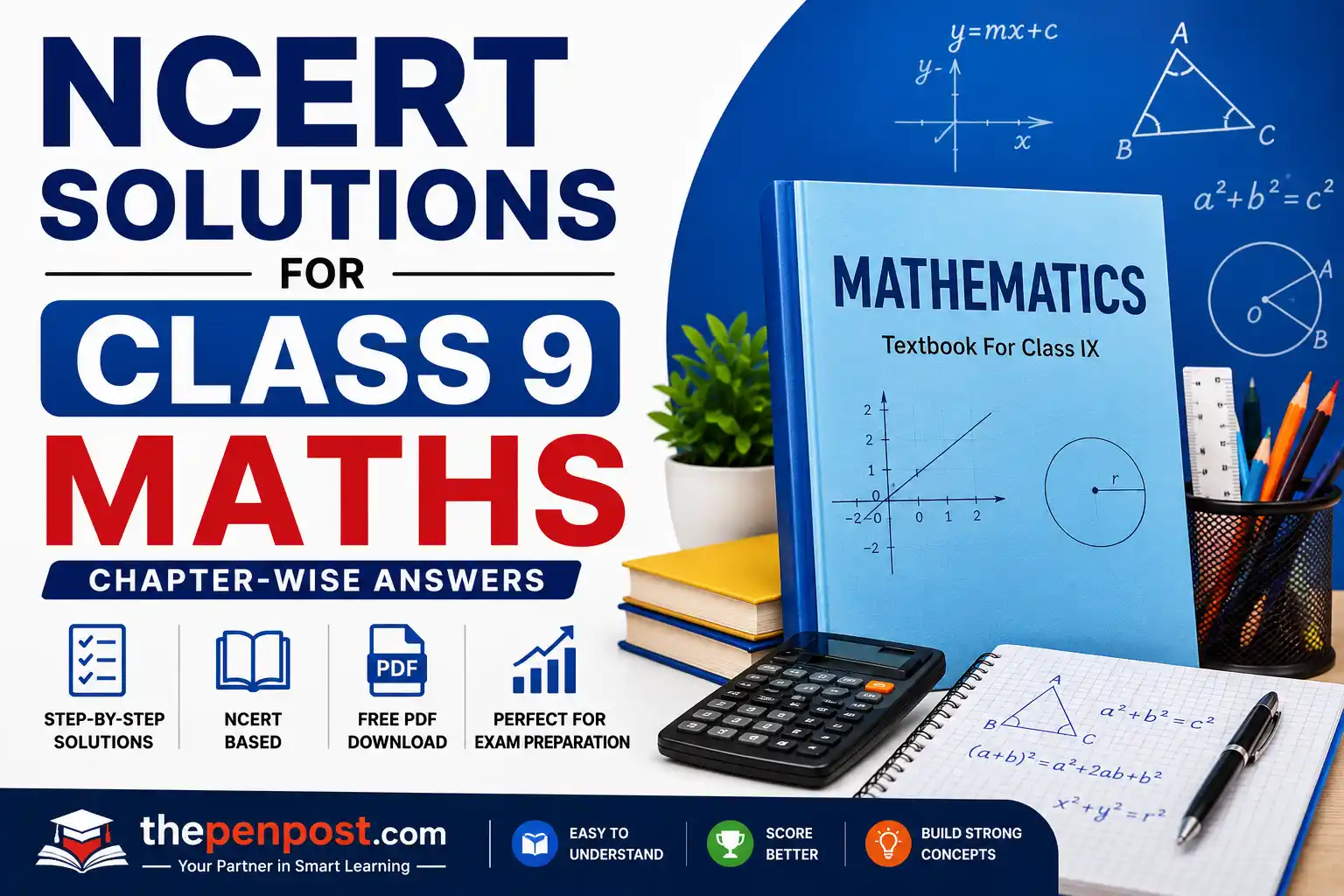
NCERT Solutions for Class 9 Maths – Ganita Manjari
Starting with Class 9 Maths can feel different from the earlier classes. The questions require more reasoning, the ideas are connected more closely, and simply memorising a formula is often not enough to reach the correct answer. A small mistake in understanding a concept can also make the next few questions difficult.
Our NCERT Solutions for Class 9 Maths are designed to help students work through the questions in the new Ganita Manjari Mathematics textbook with clear, step-by-step explanations. Instead of looking only for the final answer, students can use the solutions to understand how a problem is approached, why a particular method works, and where a calculation may have gone wrong.
For the 2026–27 academic session, NCERT’s new Class 9 Mathematics book is Ganita Manjari Part 1. The new book has a different chapter structure from the earlier Class 9 Maths textbook and places greater emphasis on understanding, reasoning, activities, and mathematical thinking. Current educational resources covering the new textbook list eight chapters in Part 1.
NCERT Solutions for Class 9 Maths – Chapter-wise
You can use the links below to open the solutions for a particular chapter.
| Chapter | Class 9 Maths Chapter | What you will study |
| 1 | [Orienting Yourself: The Use of Coordinates] | Coordinates, points, and location on a grid |
| 2 | [Introduction to Linear Polynomials] | Linear polynomials and algebraic thinking |
| 3 | [The World of Numbers] | Numbers and their properties |
| 4 | [Exploring Algebraic Identities] | Algebraic identities and their applications |
| 5 | [I’m Up and Down, and Round and Round] | Geometric ideas and circular relationships |
| 6 | [Measuring Space: Perimeter and Area] | Perimeter, area, and measurement |
| 7 | [The Mathematics of Maybe: Introduction to Probability] | Chance, events, and probability |
| 8 | [Predicting What Comes Next: Exploring Sequences and Progressions] | Patterns, sequences, and progressions |
The eight-chapter structure is reflected across current Class 9 Ganita Manjari solution resources published for 2026–27.
Why NCERT Solutions for Class 9 Maths Are Useful
A solution should do more than tell you whether the answer is correct.
When you get stuck on a Class 9 Maths question, the useful part is usually the reasoning between the question and the answer. A good solution shows that path clearly.
For example, if a question involves an algebraic expression, it helps to see which terms are combined first and why. If it involves coordinates, the solution should make it clear how the position of a point is identified. In a probability problem, the important part is often understanding what the possible outcomes are before doing any calculation.
This is why students should use NCERT solutions after attempting the question themselves. Try the problem first, compare your work with the solution, and then redo it without looking at the answer.
That simple habit is much more useful than copying a solved answer into a notebook.
What Makes Class 9 Maths Different?
Class 9 is an important transition year in mathematics. Students begin working with ideas that require more abstraction and explanation.
You may notice that questions increasingly ask you to:
- Explain your reasoning;
- identify a pattern;
- interpret information;
- represent mathematical ideas visually;
- connect two concepts;
- justify an answer;
- and apply an idea to a new situation.
The new Ganita Manjari textbook follows a more concept-oriented and activity-based approach. Current descriptions of the 2026–27 book highlight reasoning, real-life contexts, and understanding rather than relying only on routine calculation.
That means your preparation should change too. Reading a formula once and solving one example is rarely enough. Work through the examples in the textbook, attempt the exercises, check your mistakes, and return to difficult questions after a day or two.
Chapter-wise NCERT Solutions for Class 9 Maths
Chapter 1: Orienting Yourself—The Use of Coordinates
The first chapter introduces students to coordinates and ways of describing position mathematically.
Coordinates are useful because they turn the location of a point into numbers. Once you understand how the coordinate system works, you can describe positions precisely instead of relying on words such as “left,” “right,” “above” or “below.”
While practicing this chapter, pay attention to the order in which coordinates are written. The first number represents the horizontal position, and the second represents the vertical position.
Students should practise plotting points on a coordinate grid rather than simply memorising definitions. Drawing the axes yourself makes the idea much easier to remember.
Useful practice: After solving a textbook question, choose a few points of your own and plot them. Then describe where each point lies.
Chapter 2: Introduction to Linear Polynomials
This chapter introduces students to linear polynomials and develops algebraic thinking.
The important step here is learning to recognize the structure of an expression. Students often make mistakes because they treat an algebraic expression like an ordinary arithmetic expression without considering its terms, coefficients, and variables.
Do not rush through the examples. Write each expression carefully and identify its parts before attempting the question.
When checking a solution, look particularly at signs such as plus and minus. A single sign error can change the entire result.
Chapter 3: The World of Numbers
Numbers become more interesting in Class 9 because students begin to examine how different types of numbers are related.
Instead of learning number categories as isolated definitions, try to understand how they fit together. Ask yourself what makes one number rational and another irrational, and how these numbers can be represented.
This chapter is also a good place to strengthen earlier knowledge. If you are uncertain about fractions, decimals, factors, powers, or the number line, revise those ideas while studying this chapter.
A useful approach is to create your own examples and classify them. The more examples you test, the easier the definitions become to recognize.
Chapter 4: Exploring Algebraic Identities
Algebraic identities are useful because they allow expressions to be transformed without changing their value.
Students sometimes memorize identities but struggle when a question is presented in a different form. The better approach is to understand what each identity is doing.
For every identity you learn, try expanding both sides yourself. Then use numerical values to check whether the relationship works.
When solving exercise questions, write intermediate steps instead of jumping directly to the result. This makes it easier to locate an error if your final answer does not match the expected answer.
Chapter 5: I’m Up and Down, and Round and Round
This chapter develops geometric thinking through shapes and relationships that students encounter visually and mathematically.
Geometry becomes much easier when you draw the figure instead of trying to imagine everything mentally. Keep a ruler and pencil nearby and reproduce diagrams from the textbook whenever necessary.
Do not ignore labels in a diagram. Lengths, angles, and points often provide the information needed for the next step.
If you cannot understand a solution, redraw the figure and mark every known quantity. Many geometry problems become clearer once the information is visible.
Chapter 6: Measuring Space—Perimeter and Area
Measurement connects mathematics with objects and spaces we see around us.
This chapter requires careful use of units as well as correct calculation. Students should not treat units as something to add at the end. Keep them with you working wherever appropriate.
Before applying a formula, identify exactly what the question is asking for. Perimeter and area are different quantities, so using the correct formula is only the first step; the dimensions must also be interpreted correctly.
Drawing the figure and writing the known measurements beside it can prevent many common mistakes.
Chapter 7: The Mathematics of Maybe—Introduction to Probability
Probability gives students a mathematical way to talk about chance.
The easiest way to understand probability is to begin with situations where the possible outcomes are easy to list. Think about coins, dice, cards, or other familiar examples.
Before calculating, ask:
What can happen?
Then ask:
Which outcomes are favorable to the event I am considering?
This way of thinking prevents students from blindly applying a formula.
Probability questions also provide a good opportunity to explain answers in words. If the mathematical result says something about how likely an event is, make sure you understand what that result means.
Chapter 8: Predicting What Comes Next—Exploring Sequences and Progressions
Sequences are about recognizing order and identifying relationships between terms.
A common mistake is to look only at the first two numbers and assume a pattern. Instead, examine several terms and determine what changes from one term to the next.
Write the sequence clearly and compare consecutive terms. Sometimes the pattern is based on addition; sometimes subtraction, multiplication, division, or another relationship is involved.
Once you identify the rule, test it against more than one term before using it to predict what comes next.
How to Use NCERT Solutions for Class 9 Maths
NCERT solutions work best as a learning tool, not as an answer-copying shortcut.
Try this four-step method:
1. Read the question carefully.
Do not start calculating immediately. First identify what the question is asking.
2. Attempt it yourself.
Even if you are unsure about the method, write down what you know. This makes the difficult part of the question easier to identify.
3. Compare your work with the solution.
Look for the first point where your approach differs. That is usually more useful than simply checking the final answer.
4. Solve it again without help.
Close the solution and attempt the same problem once more. If you can complete it independently, you have actually learned the method.
For difficult chapters, maintain a small “mistake notebook.” Write down the question type, the mistake you made, and the correct idea. Reviewing these mistakes before a test can be more effective than repeatedly reading completed solutions.
NCERT Solutions and the New Ganita Manjari Textbook
Students searching for Class 9 Maths solutions in 2026–27 may encounter two different textbook structures online.
The new Ganita Manjari Part 1 is the relevant new Class 9 Mathematics textbook for the 2026–27 session. Several current educational publishers have already updated their Class 9 solution pages to reflect the eight-chapter structure.
At the same time, older websites still contain solutions for the previous Class 9 Mathematics textbook, which had a substantially different chapter structure. For example, older resources may list topics such as number systems, polynomials, coordinate geometry, linear equations in two variables, Euclid’s geometry, triangles, quadrilaterals, circles, constructions, Heron’s formula, surface areas and volumes, and statistics and probability.
Do not mix the two books while preparing for your school examination. Check the mathematics textbook supplied or prescribed by your school first. If your school has adopted Ganita Manjari, use the new chapter-wise solutions above.
For students using the earlier textbook, a separate archive of the previous Class 9 Maths solutions can be maintained here:
[NCERT Solutions for Previous Class 9 Maths Book →]
This separation is important because it prevents students from following an outdated chapter list by mistake.
How to Prepare Class 9 Maths for School Exams
There is no need to wait until the examination period to start solving questions.
A practical routine is to divide the chapter into three stages.
First, understand. Read the textbook and work through its examples.
Second, practice. Solve the exercise questions without looking at the answers.
Third, revise. Return to questions you got wrong and solve them again after some time.
For calculation-heavy questions, check every step. For geometry and reasoning questions, concentrate on why a particular statement or construction is valid. For probability and sequences, make sure you understand the situation before applying a mathematical rule.
If you have a test coming up, avoid spending all your revision time on the easiest chapter. Spend some time on questions that previously caused mistakes.
Are NCERT Solutions Enough for Class 9 Maths?
NCERT Solutions can provide strong support for Class 9 Maths preparation, but students should not treat them as a replacement for studying the textbook.
Start with the NCERT book. Attempt its examples and exercises. Use solutions when you need to check your method or understand a question you could not solve.
For additional practice, students can use chapter-wise questions, revision notes, worksheets, and sample papers after completing the textbook exercises.
The most important objective is not to finish a solutions page. It is to reach the point where you can solve a similar question without seeing the worked answer.
Can I download NCERT solutions for Class 9 Maths PDF?
Chapter-wise PDF solutions can be useful when students need to study without an internet connection or want to revise a chapter away from the website.
If PDF versions are provided on ThePenPost, each chapter should have its own clearly labelled download option. This makes it easier for students to download only the material they need instead of searching through one very large file.
Students should also use the official NCERT textbook as the primary reference. NCERT provides its textbooks through its official textbook portal.
Frequently Asked Questions
Which textbook is used for Class 9 Maths in 2026–27?
The new Class 9 Mathematics textbook for the 2026–27 session is Ganita Manjari Part 1. Current solution resources list eight chapters in Part 1.
How many chapters are there in Class 9 Maths Ganita Manjari Part 1?
Ganita Manjari Part 1 contains eight chapters, beginning with coordinates and moving through algebra, geometry, measurement, probability, and sequences.
Are the old Class 9 Maths solutions still useful?
They can be useful if your school is still working with the previous textbook. However, students following Ganita Manjari should use solutions that match the new textbook rather than mixing chapter structures.
How should I use Class 9 Maths NCERT Solutions?
Attempt each question yourself first. Then compare your working with the solution, identify the step where you went wrong, and solve the question again without looking at the answer.
Are NCERT Solutions free?
NCERT provides its textbooks through its official website, while many educational websites provide their own chapter-wise solution resources. The availability and format of third-party PDFs may vary by website.
Which Class 9 Maths chapters should I study first?
Start with the chapter currently being taught at school rather than choosing chapters only because they appear difficult or easy. A consistent chapter-by-chapter approach makes it easier to keep up with classroom teaching.
Can I use these solutions for homework?
Yes, but use them for understanding and checking your work. Copying an answer without understanding the method will not help when a similar question appears in a test.
How can I improve my Class 9 Maths marks?
Practise regularly, complete the textbook exercises, maintain a record of mistakes, and revisit questions you previously found difficult. Writing complete steps is also important because it makes your reasoning easier to check.
Final Word
Class 9 Maths becomes much more manageable when you stop treating every exercise as a collection of unrelated questions. Look for the idea behind the problem.
If a coordinate question is difficult, draw the grid. If an algebra question looks confusing, separate the terms. If a geometry problem seems complicated, reproduce the diagram. If a probability question is unclear, list the possible outcomes. If a sequence is difficult to predict, compare consecutive terms.
That habit of slowing down and understanding the question is more valuable than memorising a large number of solved examples.
Use the NCERT textbook as your starting point, attempt the questions independently, and use the chapter-wise solutions to check and improve your method. With regular practice, the concepts introduced in Class 9 become a much stronger foundation for the mathematics you will meet in higher classes.
NCERT Solutions for Class 8 Maths
NCERT Solutions for Class 8 Mathematics helps students understand concepts in a clear and simple way. Each solution is written step by step, so learners can easily follow the method and solve similar problems on their own. These answers cover all chapters, including algebra, geometry, and mensuration, making revision quick and effective. Students can use these solutions to complete homework, prepare for exams, and strengthen their basics. With accurate explanations and easy language, NCERT Solutions for Class 8 Maths build confidence and improve problem-solving skills, helping students score better marks and develop a strong foundation in mathematics.